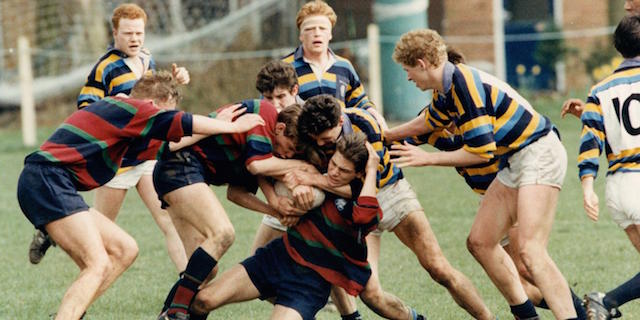
Health experts have warned that rugby could be too dangerous for children to play in schools, and have recommended that tackling be banned under the age of 18. It is a nuclear option that seems completely over the top.
More than 70 doctors, health and sports experts called on the Government to remove all harmful forms of contact from school rugby in a letter sent to ministers. Presumably none of them benefitted from the many positives of playing rugby as a child themselves.
“Rugby values” can become a bit of a cliché, but there are few other sports that accommodate all shapes and sizes and make anyone feel welcome. If you take the contact element away from the game, that will be lost immediately.
While rugby is undoubtedly a physical sport, and there is inherent risk involved, implementing a ban on contact would strip out the essence of the game for children. Playing touch or tag rugby until the age of 18 would essentially see youngsters playing a different sport. Making the jump to full contact at such a late age would be nonsensical.
Needless to say, these proposals have not gone down particularly well in the rugby community, with plenty of players and pundits taking to Twitter to voice their opinions.
Disagree with docs who want tackling banned in schools rugby. Instead teach how to tackle properly and pick teams by weight not age
— Jeremy Bowen (@BowenBBC) March 2, 2016
Ban tackling until 18 in Rugby??!! This is a wind up! Change to weight classes instead of age. Let the kids build resilience and discipline.
— Nick Evans (@nick10evans) March 2, 2016
Ban on rugby contact till age18 – scrums suddenly introduced to powerful adults would contain huge risks.
— Brian Moore (@brianmoore666) March 2, 2016
In light of the death of schoolboy Ben Robinson in 2014, rugby has had to take a long hard look at itself – and rightly so. But banning tackling is not the answer. Greater awareness of head injuries and better education of the risks for players and coaches has taken place instead.
Better coaching of how to tackle safely will also help – after all, if this isn’t taught at a young age, surely we risk players getting to the age of 18 and then not being able to tackle properly or safely. The risk thereafter would then be huge.
The most sensible suggestion of all would be to align playing groups by weight or size, rather than age – something that has been tested to good effect in New Zealand. We all remember that one kid who grew much earlier than everyone else, and everyone tried to avoid tackling at school – aligning children by size would remove such obvious mismatches. It would also develop the skills of the bigger players, because they wouldn’t simply be able to rely on their size.
Having children playing against others of a similar size would surely reduce the risk of serious injury that comes from this imbalance. If it is good enough for the the nation that has long bred the best rugby players on the planet, it is good enough for everyone else.
By Jamie Hosie
Follow Jamie on Twitter: @jhosie43
37 replies on “A ban on tackling is completely unecessary”
Nearly 300 children per year are killed or seriously injured cycling. Ban cycling for the under 18s?
Reductio ad absurdum
I like it
Personally I would ban tackles above the waist, but not because of safety issues (although there would be a decrease in concussive impact injuries like Johnny Sexton suffers with less head on chest contact) but because it would make playing the ball out of the tackle easier, making the game quicker and more expansive.
“The most sensible suggestion of all would be to align playing groups by weight”
Yes yes yes, I so agree with this, I think it would be such a progressive step at increasing skills.
I also agree with Jez over outlawing upper body tackles. This would diminish the increasing aping of the Rugby League “hit”, would be safer and would also increase offloading opportunities. It would also render the dull tactic of choke tackles largely redundant. Rugby is becoming so defensive orientated.
I also advocate changing the law on the ruck so that you would be allowed, as a defending tackler, to put hands on the ball and compete to turnover possession regardless of whether your on feet, off feet, on wrongside or whatever.
The reason for this is we see players go too far in contact safe in the knowledge that they will win the ball back, with ball carriers getting into unnatural positions on the floor and with clear outs becoming more excessive and violent the further a player goes. Make it a competition at breakdown and players will loom to go.less distance but present the ball before defends have a chance to contest.
It worked in the 80’s when I started playing…
WHAT! ridiculous suggestion. This is a game played on your feet, if you change the rules like that for the tackler then unless you change the rules for the tackled player as well every single tackle will be a turnover. The game was never like that in the 80s i think you misunderstood the rules
Leon first of all I understand that there are no rules only laws.
Secondly, back when I started playing you were allowed to get hands on the ball and basically do what you like to slow the ball down. The result being that you were coached to not take the ball into contact too far, to present it back correctly and as far away from contact as possible and to go into contact with support allowing the scrum half protection and therefore speeding up the delivery of the ball.
Nowadays players go in too far knowing full well that as soon as bodies pile in that a scrum will be called for their side. And as a result the ball is presented a lot slower and there is much more fighting for it.
What annoys me most is the way the game is coached as a contact game when in fact the object should be to avoid contact wherever and whenever possible.
But yeah, to reiterate, laws not rules.
“to put hands on the ball and compete to turnover possession regardless of whether your on feet, off feet, on wrongside or whatever”
The game is played on your feet, never in the history of the game has it been legal to put your hands on the ball when off your feet
Rules / Laws so pedantic
Perhaps it’s my 44 year old memory playing tricks on me but I certainly remember the days when you could break from scrums before the ball had even gone in, and not having to get to your feet if you were the tackler before playing the ball.
I also remember 4 point tries and the days when you could lay out an opponent in front of the flag boy with impunity as long as the ref didn’t see it (not condoning it, just pointing out how the game was once upon a time.)
Jez I can’t see that idea ever working. All you’ll create is a slow game where the defense always completely slows the ball down. Not to mention the fact that professional athletes running full throttle into players that are just laying over the ball would be incredibly dangerous.
I believe it could work (the could being because players and coaches would need to embrace it) for the following rationales:
1. Ruck ball, precisely because there is no competition, is slow now as players can and do take the ball too far into contact.
2. By allowing competition you put the emphasis on the attacking players to look after the ball and keep it out of contact, therefore creating quicker ball as scrum half’s are not digging into bodies at present, the ball will ge presented better (not between legs etc)
3. Coaches will be forced into finding other ways to either avoid the contact situation and/or develop the maul
A reply to your last comment Jez. You say “precisely because there is no competition”, but there is competition. You have to be in the right position to be competitive and on your feet, but the competition is there. If there was no competition we wouldn’t be talking about the turn over stats all the time and whether we need a genuine fetcher!? It is the job of your team mates to come in and secure it, and the opposition to try and steal. Currently it’s a very fair competition. Being able to just dive on the floor, or run round the other side of the ruck to get your hands on the ball whilst lying on the ground sounds unfair and even more dangerous.
A lot of your argument, Jez, seems to be based on the rational that slow ball in currently being created by the attacking team not presenting the ball properly, when I don’t think that is the case. Slow ball happens when tacklers don’t roll away, when players attempt to steal the ball off their feet and end up laying horizonally over it. Amending the laws as you suggest would just perpetuate the problem.
The way you appear to want the game to go it to encourage no breakdowns by making them impossible for the attacking team to retain ball. Personally I’d hate that. If you don’t want a contest at the breakdown then rugby league is the game for you.
When coaching Rugby (pretty successfully) I have a fairly simple ethos. This is best shown by the first two things I do when taking on a new squad (primarily with youth teams but does work with seniors.)
Firstly I ask the question what is the best form of defence, to which the answer is attack.
Secondly I line up two parrellel lines of players and then ask each player what they see in front of them. Most players point at the player opposite (I bet Jamie Roberts would) but very occasionally a player will point between two players and say I see a gap. Congratulations, you’ve just found your captain and/or playmaker.
Now, I understand there will always be breakdowns (but the way they are done at the moment is not conducive to quick ball, more on that later) BUT, you are incorrect to sat that the point of the game is to create breakdowns. The point of Rugby (when done well) is to avoid breakdowns, to create space and to keep the ball alive. As a great coach once said to me, keep the ball alive, score try, collect 5 points, field restart and repeat.
Now the best way to do that is not to give defending teams the opportunity to get hold of the ball legally or not. And this is where my idea of allowing more competition at the breakdown works. As in if you know that there is a chance that the defence have a chance of winning the ball at the breakdown the attacking player will enter that situation with greater care, presenting the ball cleaner, earlier and more speedily. It maybe that players have greater opportunity to pop up to supporting players (as opposed to the current waiting to pick up we see), or offloads in the tackle (how France would be improved by a Yannick Jauzion at 12 for instance) or even shock horror the maul being used as quick ball.
Basically the least amount of breakdowns you have to enter results in the defence working harder with little effect. It’s certainly the way the All Black’s play and see how successful they are (how many times does SBW take the ball to ground for instance)
I’m unsure why you feel the need to lay out a CV on here, not one other person on this blog pushes their success on the pitch personally to validate their opinions further. You could have coached Premiership rugby for all anyone cares, your points can still make no sense.
There was also no point that I said that the point of rugby is breakdowns. But, breakdowns are an invaluable part of what makes rugby union the sport that it is.
Your points about players being intelligent and using space is again completely irrelevant. As you quite rightly point out, NZ are brilliant and utilising space; they’re also brilliant at the breakdown.
Back to the actual point that I disagreed with before you began your coaching lecture. My point is that by allowing defenses to turn rucks into what would essentially be a playground style bundle would just lead to defenses killing the ball at most breakdowns. Even if ball placement was perfect, defenses wouldn’t have to do much to get their hand near and would then not have to release the thing.
The only thing a rule change like that would do is mean that rucks become a non-part of the game, a part that would not be possible to carry out constructively. As a fan of the sport, I don’t see how removing one of it’s most integral parts would improve it.
I don’t see why you’ve got so defensive?
1. I just say I’ve coached and given my opinion based on my experiences. Yes I’ve been successful, I think, and so therefore does add a level of validation to what I’ve said, but it’s not saying that your opinion is worth anything less. You are entitled to it. However:
2. You don’t give me the same courtesy as basically you say I am talking rubbish despite my evidence of coaching successfully in the way I describe and
3. You obviously didn’t read my points correctly as I never
A) suggested the breakdown isn’t an essential part of the game, it certainly is
B) I’ve only suggested that by allowing a greater level of competition at the breakdown (and that doesn’t mean turning it into a playground bundle) the onus will be put on the attacking side to protect the ball in the breakdown situation which will only result in quicker and more expansive rugby being played because
C) coaches will work out that the most effective way to coach the breakdown is to avoid the breakdown wherever possible or to find ways to get the ball from the breakdown earlier. See for examples Nowells try vs Scotland, Ford vs Italy and Hogg pop to Hardie vs Wales.
The avoidance of the breakdown is the most effective way of a) playing the breakdown and b) creating space to be exploited.
I would hope, and certainly would think that Eddie Jones for instance, that most coaches would agree with this as an ideal to strive for whilst acknowledging a level of pragmatism in relation to the breakdown. I do also think that a different level of competition at the breakdown will aid this development.
Weight groups is a far better idea. Anyone who saw the interview with the Vunpolas recently will have seen the size of Billy V when he was 9. Twice as big as the kids two years older!! Having kids split into wight categories would eliminate a lot of the dangers inherent with tackling kids his size.
Weight groups makes far more sense for a safety, skill development and participation point of view. No kid should be excluded from participating because they are currently too small, many catch up eventually anyway.
But for Billy V ….If you look about 100kg aged 9 it’s difficult to find any sensible match ups by age or weight. The mould was well and truly broken when he came out of it!
Ha pretty funny reading this comment. I’m 2 years older than Billy and played against him a couple of times growing up, it didn’t end well for me. Interestingly he did actually play up a couple of years because of his size.
Agree with this article but why does there have to be any change at all? People of all shapes and sizes playing rugby is a key part of its attraction and culture. The data she used showed 28% chance of a student playing 15 matches being injured. Simple googling (probrably something that Pollack failed to do) found data from the biggest US study of students playing inter-school sports from 11 to 18 showed that during one season 25% of baseball players would get injured with 45% feeling severe arm pain. 22% of soccer players would also pick up an injury. It reckoned that of the 7 million kids playing inter-school sports in the 2005-6 season 1.4 million (that is 20%) would pick up an injury…I suppose you could swap baseball for cricket to get a UK perspective. Injuries happen in all sports / recreational activity and day to day life. In fact I think that inuries (and the fitness work to mitigate) are again part and parcel of rugby culture. Perhaps her time would have been better used encouraging more kids in the Uk and US to take up sport to avert the obesity crisis? I also note that there is no mention of womens rugby where the differentiation of skill, size and (often, not always) standard of coaching is much more glaring.
I think this site needs a “+1” / “upvote” / “chapeau” function.
I have nothing to add to Santiago’s comment, but would like to record that, in my opinion, it makes a number of excellent points very effectively.
Thumbs up to Santiago. My experience of playing school rugby in 80s for 7 years was very positive. I only had one injury in 7 years when i missed 6 weeks games. Plenty of cuts, abrasions and bruises. I remember my shoulders and ears getting battered from being a Prop. It made me a strong and confident young man.
There are plenty of other more dangerous activities. How many kids are kill or seriously injured riding ponies?
I do agree we need to continually improve coaching so that we can manage down the risks.
Taking risks as a kid is very important
Well said Rich I forgot about my 5 years playing Saturdays at school and can only remember one player going off injured which was a winger we targeted to remove from the game, hit hard and safely but rattled none the less.
I have so many issues with this call for action against tackling, I won’t go into them all. The one thing I agree with the authors is that there probably needs to be better surveillance on injuries, as more data never hurts, and might be able to guide how we use medical services to deal with injury (ie ensure there’s a physio at every game – I still remember a friend’s dad who was a urology consultant was basically the on-pitch doctor for my school’s 1st XV, not great really).
However, I wholeheartedly agree with Jamie that the best thing that could be done to reduce risk is copying the NZ approach of grouping players by size/weight. Should have the short term effect of reducing the mismatch between tacklers/runners thus reducing injury, and also in the long term put emphasis on all players developing core skills, which surely would benefit the national team in the long run? You could imagine the product is a player like a Billy V with deft hands, or Keiran Read 😉
Is the picture from a RFC Coppertop game?
Whoever it is I hope the ref blew for a high tackle
Putting to one side the utter nonsense from these health experts (aren’t we all experts these days?), what age do children start playing full contact today? I know the RFU has made significant changes over the past few years and I absolutely agree with all posting above that kids need to learn to tackle and be tackled properly as they learn the game. I do wonder whether the weight issue is now more important in the age of the professional game as players age 15 upward seriously start to push the weights and bulk up in order to play at the higher levels of youth rugby. There has always been a problem of boys playing men at the U14/U15 level and I imagine that this only gets worse with what seems (in England at least) to be such a pre-occupation with size at top levels. Separately, and it’s just a thought, I wonder whether reducing the focus on contact and size up to the U16 level and instead focussing on handling skills might up the skill base so sorely lacking in NH rugby just now.
Under 9 is when they start contact.
This whole conversation is a joke and I wish people would get off the wagon. Getting up in the morning “could” lead to death, walking to school, biking to school. This has no end.
It is bigger than Rugby it is Always the same a bunch of people who do not participate telling the others they shouldn’t. Freedom of choice, take responsibility for your actions, if you choose to play rugby then you run the risk, the death rate in Rugby is low compared to horse riding, cycling, fishing for God’s sake.
I am a teacher in a school (in Brazil) where if humidity is lower than 20% we do not do PE, if it rains we do not do PE, if it is above 28 degrees we do not do PE. Guess what there is not a lot of PE happening and people are fat and badly behaved in Class.
PLEASE PLEASE, do not go down this roote, sign a disclaimer when you atart playing and make a decision, if you do not want your kids playing then that is up to you. But for heaven’s sake do not proibit my kids from playing.
Its not about people ‘choosing’ to play rugby. Its about children in PE lessons who have no choice if rugby is compulsory at your school then the bigger kids get a chance to run into you and hurt you.
A life lesson then – we all have to do unpleasant things. Better get used to it
Given the choice 99% of children will plump for sitting in the warm fiddling with computer games or phones over running around in the cold, wet and mud being jumped on by other boys,
Given the choice, obesity would be a much greater problem than it is now.
This is why we don’t give children the choice
Some of those who were forced into rugby may well end up loving it. I know I did
Firstly,Ronnie I sincerely hope you don’t teach spelling!
Secondly,not one of the comments here supports the banning of age group/school rugby. All I’ve read are suggestions and observations made by rugby enthusiasts who acknowledge that something may have to be done in order to PREVENT a blanket ban on the game being played by kids.
I wonder if the professional game is willing to take the lead here by altering the “size first,skills second” mentality that currently pervades in the pro game in the NH?
I can only see a couple of minor “typos” in Ronnie’s comment…
I think if you look at this current England squad compared to the other NH teams you will notice a big difference in size of the backs. Care/Youngs, Ford, Farrell, JJ, particularly compared to Davies, Biggar, Roberts and JD just for example!?
Obviously you want your forwards to be a bit bigger because of the nature of their positions and roles on the pitch, but I think EJ has changed the outlook of our team by picking more skilled players. When Slade is fit, he just adds more skill.
I take your point Dazza but there is no direct correlation with the current size of England’s backs and the issue raised here. My point was made to invite pro rugby to consider a step change in current thinking. Does the game need 16/17 stone backs and 20 stone forwards? This after all is what is driving the gym culture ,particularly among lads from the age of 18 onwards. If top level rugby decided to go back 20 years in terms of player size and power that would automatically remove the need for huge,high impact “collisions” and the rise of related injuries and long term medical complications.
JJ, Daly and Slade actually add weight (pardon the pun) to my argument. All realtively small guys in todays terms,but all immensely skilful individuals redolent of times past who are able to hold their own in the land of the giants. Makes you think.
You should listen to the interview with one of the “experts” on Radio Scotland yesterday (2nd March) morning, he was up against John Beattie. Following exchange:
“expert”: are you willing to subject children’s health so that rugby will played at a higher standard?”
JB: “Look, I have a child who plays rugby and a daughter who plays football … so don’t pin that on me”
http://www.bbc.co.uk/programmes/b07146zd interview is about 2:36:00 into the program.
MP’s who rule on this should be vetted to guarantee that 50% of them at least have played the game and know what they are on about.
Otherwise it’s the same old absurdity of reactionaries and ignoramuses telling us what we can and can’t do (a la nanny state)
The analogy with hunting could even be made here (a similarly innocuous past time by most rational measures practised as a leisure pursuit and still with as many advocates as decriers.)
Really…..?