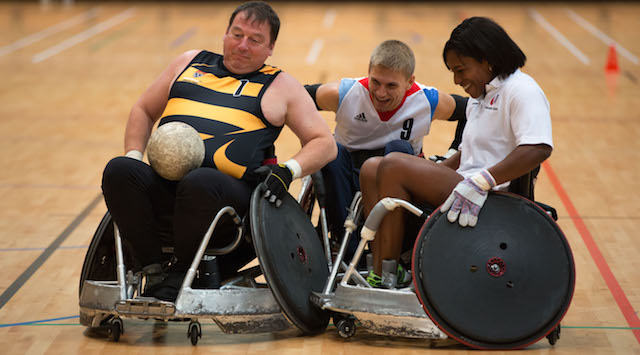
Attacking from deep in his own half, the player takes a heavy tackle from Maggie Alphonsi. Spotting Rory Lawson in space, he launches a pass to his right and the former Scotland scrum-half catches it and accelerates away from Tom May to score a try.
Although this could be interpreted as an excerpt from a hardcore rugby fan’s fever dream, or perhaps a Comic Relief event (no doubt involving Jack Whitehall) it is actually taken from a different ball game entirely. Quite literally, in fact, because the three former stars were taking part in a wheelchair rugby match at the Copper Box Arena at Queen Elizabeth Olympic Park, organised by rugby charity Wooden Spoon to show what it takes to be a wheelchair rugby player.
As the charity’s Ambassadors, Tom, Maggie, Rory and Rachael Burford were put through their paces by Canterbury Wheelchair Rugby Club and Steve Brown who captained Team GB at the 2012 Paralympics. A high-tempo mix of several sports, wheelchair rugby has been growing in popularity since its official inclusion at the Paralympics in 2000, and the World Wheelchair Rugby Challenge earlier this month represented the first time wheelchair rugby has been broadcast on television as a standalone event. As one of the high-profile figures in the sport, Steve Brown is delighted to see the surge in support for wheelchair rugby.
“The coverage is fantastic; it’s great to introduce new people to the sport and have it looked at in a different way but really, it’s gaining recognition in its own right which is what I’m really pleased about,” said Brown.
“It has seen huge growth from London 2012 where it was a flagship sport; it sold out before any of the other Paralympic sports did. From there it’s been part of the Invictus Games, and is now being broadcast as an event in its own right, not as part of a multi-sport event, but just as wheelchair rugby. Once people see wheelchair rugby they want to see more and giving the public an impression of what the sport looks like is very important. You mention ‘football’ to anyone in the world and they’ve got a mental image of what football is! With more coverage hopefully we can get nearer that situation for wheelchair rugby.”
For the uninitiated, wheelchair rugby is a four-on-four sport incorporating aspects of wheelchair basketball, rugby, basketball, Australian Rules football and American football. Played over four quarters of eight minutes, teams have 40 seconds of possession to score before the ball is turned over to the opposition, and so a frenetic pace is sustained for the best part of an hour, once you take stoppages into account.
Each player is classified based on their strength and muscle function, on a scale from 0.5 to 3.5, and each team’s four player total must be 8 or less. Made popular (or notorious, depending on how you look at it) by the 2005 documentary ‘Murderball’, the sport does involve heavy chair-on-chair contact and Steve recognises that the variety of influences on wheelchair rugby makes it a highly entertaining and accessible sport to watch and play.
“[The influence of other sports] helps wheelchair rugby’s appeal internationally. You look across at Canada and USA, and they’re good at the sport because of the American football and basketball influences, and Australia are good because of the familiarity with Aussie Rules. What wheelchair rugby does is replace areas of rugby that you can’t do in wheelchairs – like scrummaging and lineouts – with rules from other sports that make the sport better.
“In my opinion, it takes the best of a lot of sports, and makes one awesome sport! Whether you’re able-bodied or not, it’s a sport that can capture your imagination with the long passes and the big hits, but also because of the tactical nature of the game.”
Make no mistake, the sport is hard, fast and extremely tiring. All the Wooden Spoon Ambassadors were struck by how demanding the sport was, be that physically or mentally.
“It’s amazing to see how these guys can move the chairs around,” said Tom May, having tried his hand at it for the first time. “[They’re] unbelievably fast and agile – I found going in a straight line hard enough! Coming from rugby, where it’s important to have a big, strong upper-body, it’s interesting to see that all the players have really lean, athletic builds and strong shoulders and are way more capable of controlling the chair than I am!
“Considering that some of them have limited use of their hands and arms, it’s amazing to see what they can achieve. There’s such a competitive edge about the players, and I think it’s pretty easy to forget that you don’t lose your competitiveness or love for sport when you’re involved in an accident and you sustain an injury. As impressed as I am by the physical side of it, the mental strength that they have is perhaps even more remarkable.”
Ex-Scotland scrum-half Rory Lawson said: “I love the fact that the values of able-bodied rugby have been carried through to wheelchair rugby so well. Traditionally, rugby has always been about including different shapes and sizes, anyone can play the game who wants to. For me, learning about wheelchair rugby and the points system which allows for players with different physical limitations to participate – not only that, but to have a tactical role in the game – is absolutely terrific.
“Being in amongst those boys, there’s no difference to a rugby training session in terms of attitude, mindset, effort, teamwork, discipline. It’s been a real privilege to be involved, to be able to share the court with some of these guys because it’s really inspiring.”
Rachael Burford, who won a World Cup last year with England, is similarly impressed. “Wheelchair rugby, and Paralympic sport in general, goes to show that there are so many outlets and opportunities for people and that things like teamwork, camaraderie and support is not something that you lose when you’re disabled,” she said.
“The feeling of inclusion is something that I felt was key when I was talking to some of the players, and they’ve all found themselves here, so there’s no reason for others to feel like they can’t do the same.”

Although at the top level, wheelchair rugby has worked its way into the public eye, Rory maintains that the sport needs to have continued backing to ensure that there is a foundation of grassroots teams on which the sport can build.
“Like a lot of these sports it needs support. They’ve got to have financial support and they’ve got to have volunteers and people wanting to get involved in the game. That’s one of the great things about the involvement of Wooden Spoon and you can see the benefits that these players get. But we’re seeing it in its best light; Steve Brown is coaching these guys, in the Copper Box on the Paralympic court.
“For the boys from Canterbury Wheelchair Rugby Club, one of them was telling me that they play in an old school hall, and there are holes in the floor and it’s a bit like a bog! So although it’s great for these guys to be involved in this environment and to see what it’s like at this level, there has to be support at the grassroots level, so that you get the players working up to the national teams and Team GB.”
Having had my eyes opened by the sport, I’ll certainly be watching the wheelchair rugby when Rio 2016 rolls around and it seems that the assembled rugby great and good share that opinion.
“Oh absolutely [I’ll be watching it] – for the collisions if nothing else!” said May. “Even here, two lads almost went flying out of their chairs earlier. I’ll definitely be having a watch, and having experienced it I think I’ll be able to appreciate it that little bit more. It was a bit frustrating being man-marked by Rory Lawson all game though.”
Lawson added: “I had a terrific time and it’s a great sport. I thoroughly enjoyed it, even though I don’t think we scratched the surface of the tactics. But I was marking Tom May, I had him in my pocket all the way, but I had to let him in for a couple at the end as a consolation.”
With the sport’s stock riding high and the 2016 Paralympics in Rio right round the corner, there seems like no better time for the wider public to throw their support behind wheelchair rugby.
By Fraser Kay (@fraserkay)
Wooden Spoon, the children’s charity of rugby, helps highlight the power of Wheelchair Rugby with Wooden Spoon ambassadors Rory Lawson, Maggie Alphonsi, Tom May and Rachael Burford being put through their paces in an inspiring training session with ambassador and Team GBWR captain Steve Brown.
Rugby provides Wooden Spoon with its core values of Passion, Integrity, Teamwork and Fun, and the charity believes every child and young person, no matter what their background or ability, should have access to the same opportunities. #wearerugby. For more information visit: http://wswearerugby.org.uk/