The Twickenham faithful may well have headed to last weekend’s mega-clash with Wales with the belief that the best thing to come out of Rugby League was Sam Burgess. They probably won’t have left with that same thought. Most people, though, are totally oblivious to the greatest Rugby league import: the dummy runner.
The dummy runner is ubiquitous at all levels of rugby. If you play at a lower level you will probably be familiar with the following scenario: a scrum half fires a pass at an onrushing flanker, the flanker ducks to avoid the pass and is smacked him in the side. He falls to the floor to be met with cries of “for Christ’s sake Gary, always expect the ball” from all around him.
Dummy runners work precisely because they must be accounted for. They create an advanced attacking line which pins back the defence and allows the attacking team to move the ball wide quickly.
Welsh Dummy Runners
Wales’ previous game was against the minnows, Uruguay. It was always going to be a win and the Welsh could deviate from their strict “Gatland Ball” game plan and throw the ball around a bit more. What makes the below play – one of many examples of their use of this tactic in the game – interesting is that the try is on anyway because they have a seven on six overlap, the addition of Scott Baldwin’s dummy run is that it makes this a nailed on try because it turns it into a seven on three.
Here’s how it went down:
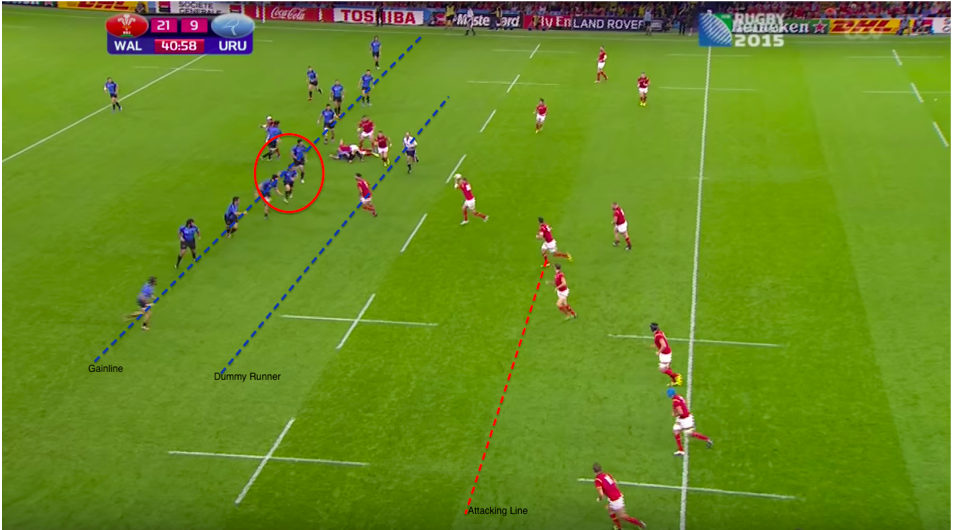
1. Baldwin runs a hard line yards away from the ruck, this ties in three Uruguayans.
2. Priestland reads the space outside the Uruguayans: if they rush up he will run through the gap, if they don’t he will ship the ball.
3. The outside player is isolated and rushes up to stop the pass. Priestland lofts it over him to Tipuric, he passes on to Hallam Amos who goes back inside to Cory Allen for his hat-trick.
English Dummy Runners
Against Fiji, England didn’t use that many dummy runners. They used plenty of short passes to forwards to advance play but there was no deeper receiving option on these plays. They used dummy runners exclusively near to the Fijian line, where they attempted to take control of the midfield and exploit the wings.
Here’s how it went down:
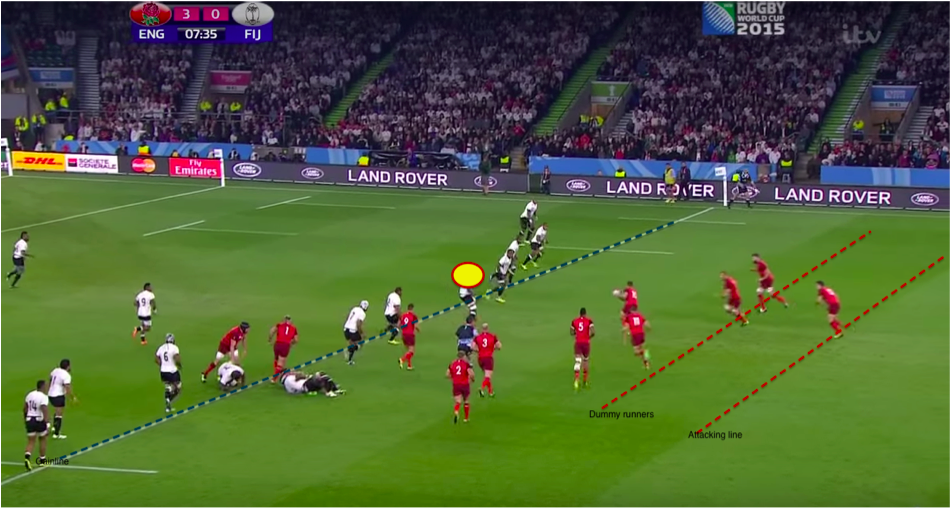
1. George Ford takes the ball ahead of his two dummy runners. He fixes the yellow highlighted player who cannot drift off the fly-half and therefore acts as a barrier to the two Fijian players to his right.
2. If Ford moves the ball to Robshaw, first dummy runner, then they will still have a 4-on-2 on the next play. If it goes behind to Barritt then they have a 4-on-2 on this play because the dummy runners fix the two defenders ahead of them.
3. He does go to Barrit and it’s only poor passing which prevents England from exploiting the overlap.
England vs Wales: The Dummy Runners
The first use of a dummy runner by either team was Wales in the 13th minute, and it wasn’t pretty.
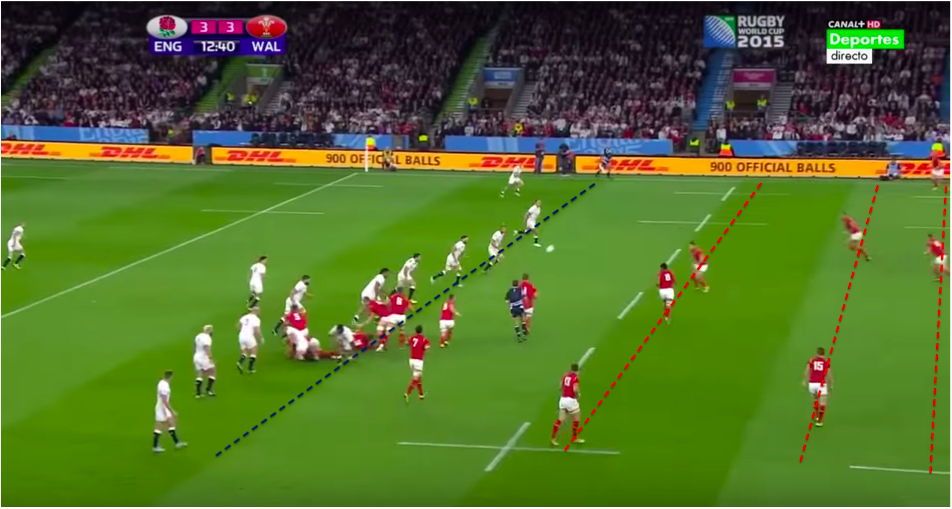
Now, look at the above play and remember what we’ve said about dummy runners. They work when defences have to account for both the dummy runner and the player behind, or the ‘live’ runner. This play starts poorly because the pass to Biggar is looping and means he has no opportunity to advance and fix a player. Incredibly the dummy runner here is Jamie Roberts who is roughly 15 yards away from the gain line and the live runner is Hallam Amos, five yards even further back.
The ball goes to Roberts who loses yards. The play doesn’t work because neither Roberts nor Amos are legitimate threats as they’re far too deep; in fact, the play is so slow to develop that Roberts is tackled by Barritt who is two out from the ruck in the above photo. England have effortlessly drifted across.
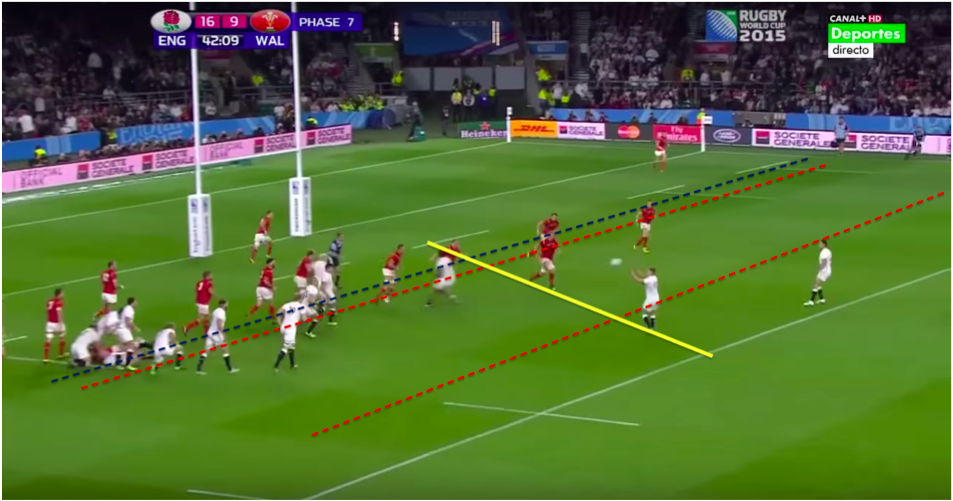
In the above play we see the effect that flat dummy runners had on Wales’ defensive line. Dan Cole and Billy Vunipola hit the line hard, freezing everyone inside Bradley Davies, indicated by the yellow line, and offers a big dog leg for Farrell to exploit. The fly half, knowing that a penalty is coming, lofts a pointless kick well into the dead ball area and they go back to kick the points. Had they had more ambition, they could’ve tried to exploit this overlap with passes.
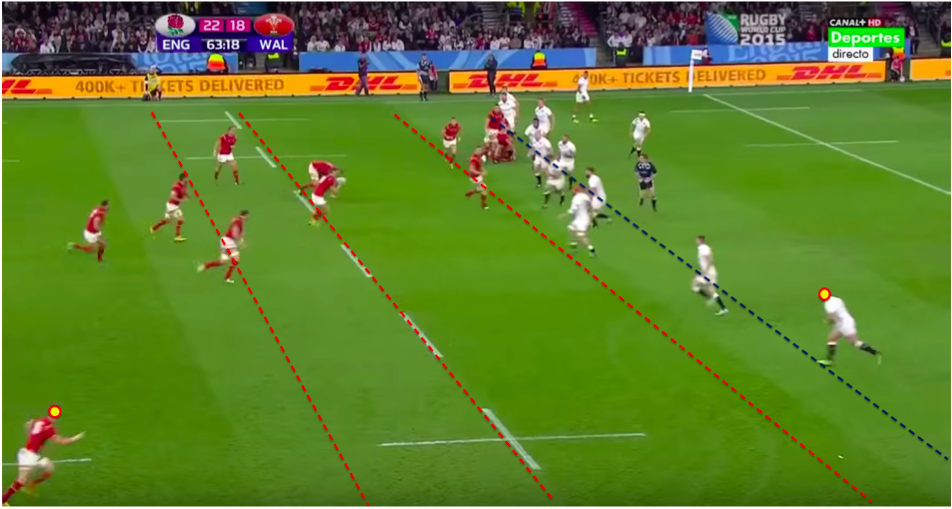
This picture seems to show Wales suffering from exactly what they were suffering from previously in the game, a lack of attacking threat from the dummy runners and too much depth. But the reason this play works is because of Bradley Davies’ initial dummy threat. You might think that someone who has already turned around to see where the ball has gone is no threat at all, but because he is running a hard line at the fringe defenders he immediately prevents them from pushing wide.
The three Welsh players in midfield – each with the potential to attack wide – against two English forwards means that Barritt, under the yellow dot, cannot push out to cover Liam Williams’ (the other yellow dot) wide run. The Scarlets fullback gets the ball and makes yards into the English 22 before dropping the ball.
This perfectly illustrates why dummy runners work. The dummy closest to the ruck fixes the fringe defenders. The live runner in midfield fixes men inside and outside of him because they cannot drift without leaving a huge hole. The outside backs then have an advantage over a defence that has been narrowed so much.
5 Keys to Implementing Dummy Runners at Your Club
1. It’s not just forwards that need to ruck: It’s important that you don’t have just forwards moving between rucks. This results in very tired forwards and slow ball as eight tired players just lie on the rucks. Instead, if the ball goes wide your wing, centre or fullback should be securing the ball and your forwards can stay in midfield as a crash ball option or to use at the next ruck – or as dummy runners!
2. Always expect the ball: I mentioned it earlier but I cannot stress it enough, a dummy runner who comes ambling through with their hands by their sides is of no use. Constantly remind your forwards and your scrum half that the dummy runners are options.
3. Only the 9 and 10 make the decisions: Often, a scrum half will come up with the ball to be met by 14 players all shouting “YES!” with their palms outstretched expecting the ball. This is confusing for everyone. The 9 should be the decision-maker and he will either give it to the dummy runners or in behind to the 10. The 10 is responsible for everything outside of him and he should always expect the ball.
4. Forwards are involved at every play: Picture this: a pod of three forwards are dummy runner options, the ball is played in behind to the live runner. What do they do now? At most amateur clubs they would pause and hope the ball comes back round to them soon. They should be working around to offer themselves as an inside option off the scrum-half or 10.
5. Keep it Simple: This is the most important point of the lot. It’s all well and good to plan to have three different dummy runner options on every play with a live runner in behind. In reality though, when it’s sleeting and the season-old Gilbert is covered in mud and crap, this isn’t possible.
The best thing you can do is give your players awareness. Am I a forward? Yes. Am I in midfield? Yes. Are there colourful booted and spiky haired backs alongside me? Yes. I’ll run a hard line and see whether I get given the ball; if not, I’ve hopefully held a defender and opened up a gap wider out.
By Sam Larner (@SamLStandsUp)
Wales dummy runners? Worked a treat against England for the one line break they achieved, that came from an individual error, and was easily defused by a covering defender. The Welsh midfield attack is predictable, easily defended and totally negative. (And that’s not saying England are any better.) Both teams run one angle and repeat before kicking away possession. You want to see how to do it properly, watch Australia who are the best at it or NZ.
Shouldn’t the title be “How Wales runners beat Dummy England”?
Dummy run’s have their moment, and I wish Cuthbert was always the dummy, less time he has the ball the better. (I’ve ran out of patience with that guy)
But I think something is being overlooked in all of this, if you attempt the dummy run and remember “they are options” the problem is, some players go into autopilot mode and just run with hands up with no intention of catching, then they just run into the opposition and give away needless obstruction’s. It happened a fair bit in todays game, not to much “dummy runs” but “watch me run in the way of the opposition when I have no intention of being involved in the play”.
What commenters often refer to as “slowly returning” or “looking a bit tired” is more often than not, veiled obstruction with intent. Both Wales & Fiji did it tonight and it frustrated the hell outta me. If it’s part of fast attacking movement that’s fine and what we want to see, but when it’s slow paced it’s just obstruciton
On point 3 – surely 14 players all shouting Yes and looking like they might receive the ball is exactly what you want? Keep the oppo guesssing and having to prepare to defend multiple possibilities. Yes, the scrumhalf will make the decision and he probably already has in mind his preferred option, but the more options the opposition thinks he has the better.