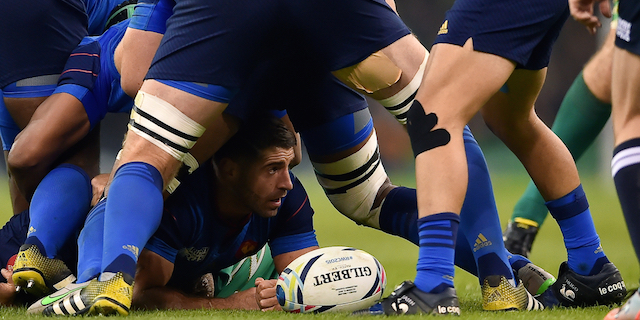
At the most basic level, the more complicated you make an attack, the more likely it is to fail. It follows, then, that whenever you add an additional pass to a move you increase the likelihood of failure. Of course, if a defence does its job then you will have no option but to go wider to try and break it down.
But there’s a potential soft spot in every defence, around the fringes of the breakdown. These areas immediately left and right of the breakdown should be defended by ‘pillars’ or ‘guards’ to stop the attack running straight through them – but often there are ways of manipulating them to your advantage.
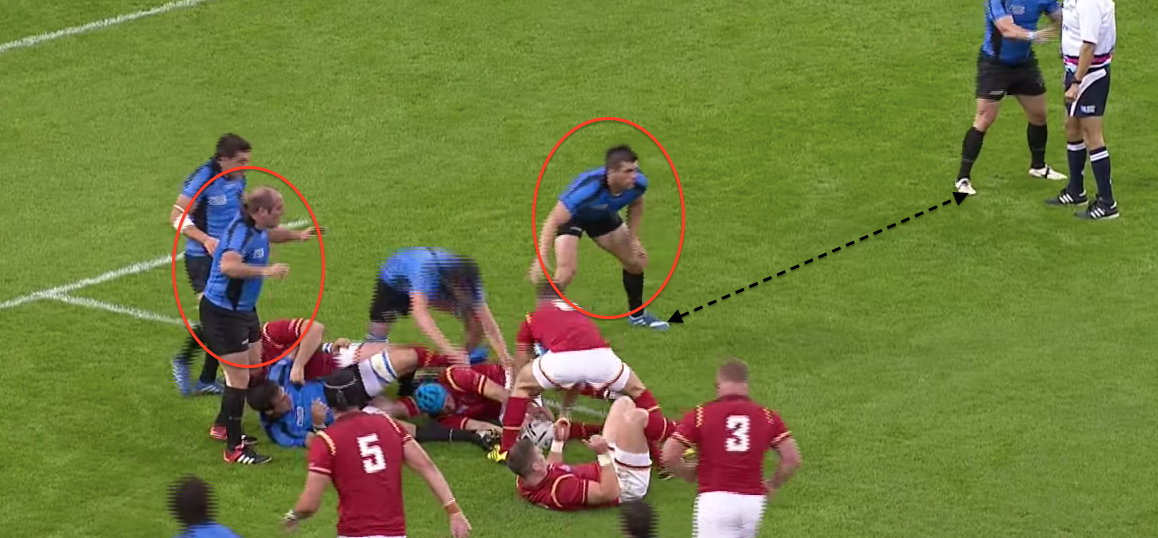
As you can see in the above picture, the two Uruguayan guards are circled. Now, this is far from perfect example. The right guard is looking into the back line, so Wales can gain yards on his inside shoulder. Also, the man outside him is far too wide and he has to watch both his inside and outside shoulder. The best defences set themselves up so that they only have to defend on one shoulder. The other important thing to remember is that the breakdown blocks defenders from moving around it – once the guard leaves his post he also leaves a gaping hole in his place.
Technically, setting up your guards should be easy – after all, it is just two people stood next to the breakdown. The issues, however, come when speed of thought and offloads are introduced by the attacking team, making it difficult to know which players around the ruck should stay as the guards.
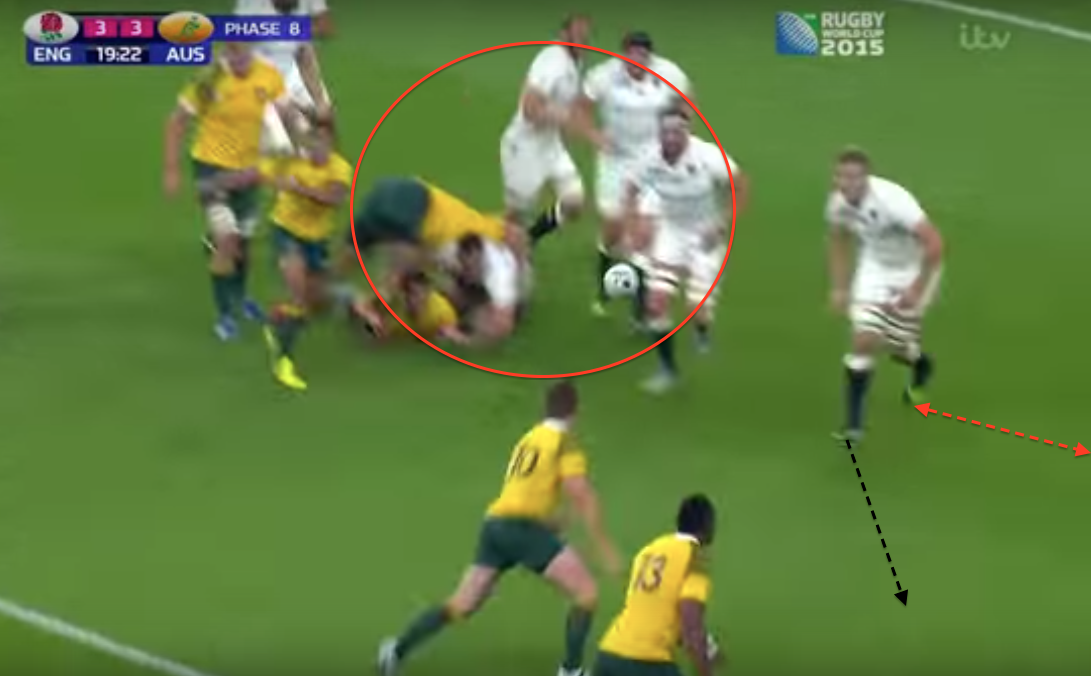
As you can see from the photo above, England are in a difficult situation after an Aussie half break. There are three English forwards all covering the guard’s space, and because they haven’t pushed out it stops Launchbury from moving over to cover the danger. The black line shows where the lock ends up going but in reality he needed to be sprinting over earlier, and trusting that one of the inside players can cover his inside shoulder.
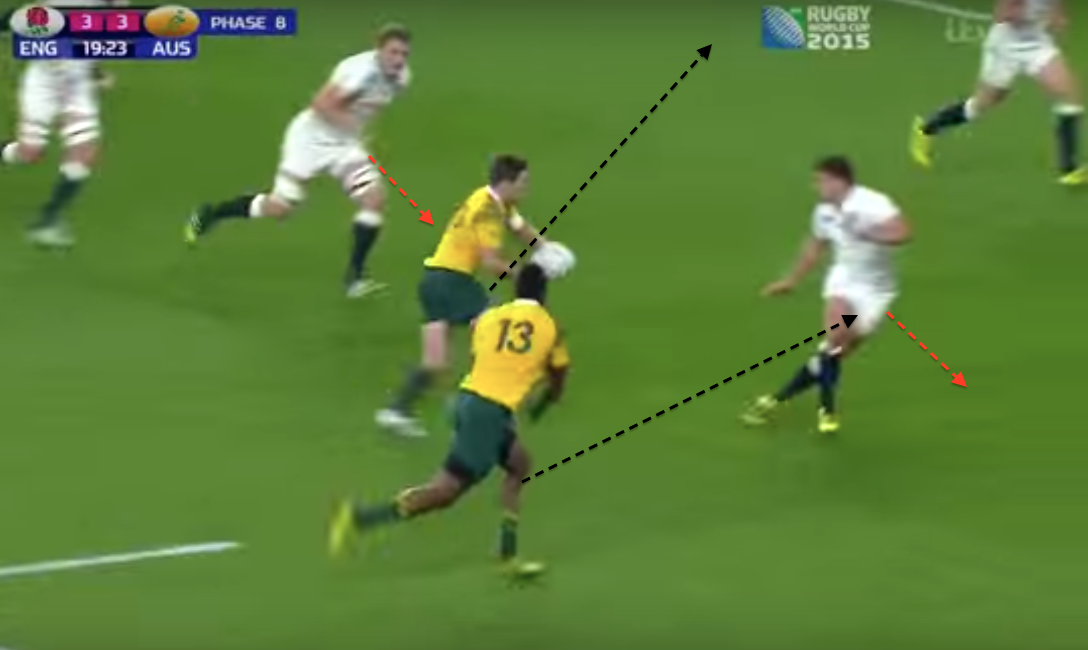
The result is that Ben Youngs drifts too soon and Launchbury can’t close the gap, leaving a massive hole for Foley to run through and score the first try of the game. Although the line isn’t broken at the fringes, the try is scored because of the confusion that occurs there and consequently handicaps the rest of the line.
The Irish are masters at exploiting frailties in the opposition fringe defence. One of the main reasons for this is Connor Murray’s threat to run the ball, this forces defenders to stay tight to the fringes, if they don’t he will run through, if they do then there’s a lot more space to exploit out wide.
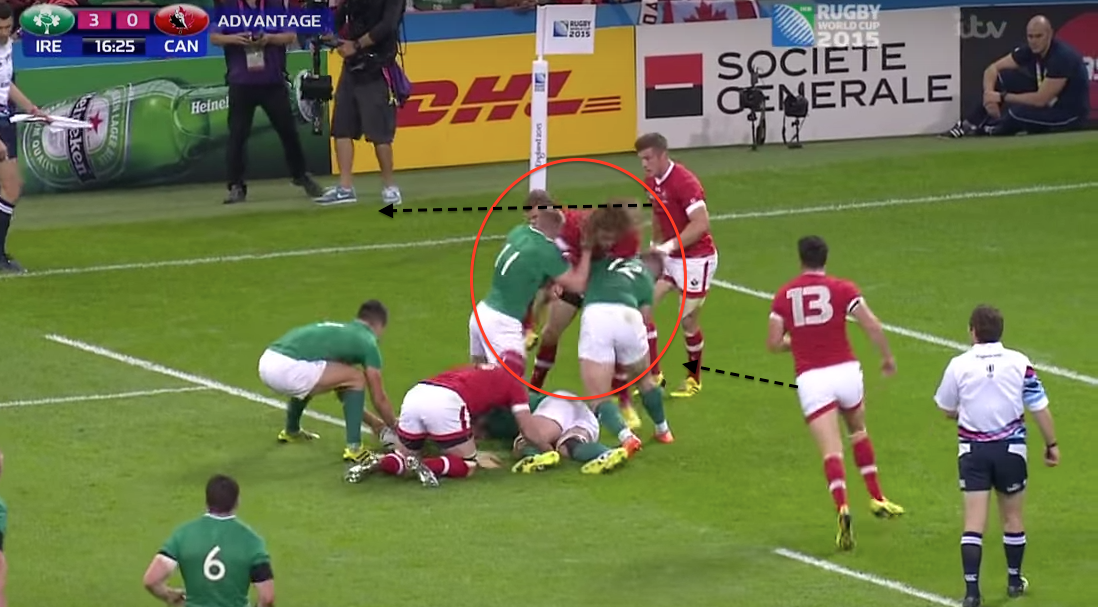
In this photo Murray has options to the left and the right but he also has an option straight through the middle, because Luke Fitzgerald and Keith Earls have cleared out the Canadian and left a large hole over the breakdown. Murray runs through it and is brought down just before he reaches the line, but Ireland score on the next play.
In this next photo we see one of Ireland’s most common plays. The first receiver takes the ball and has three options; hit up himself, pass outside or pass back inside to a player coming around the breakdown.
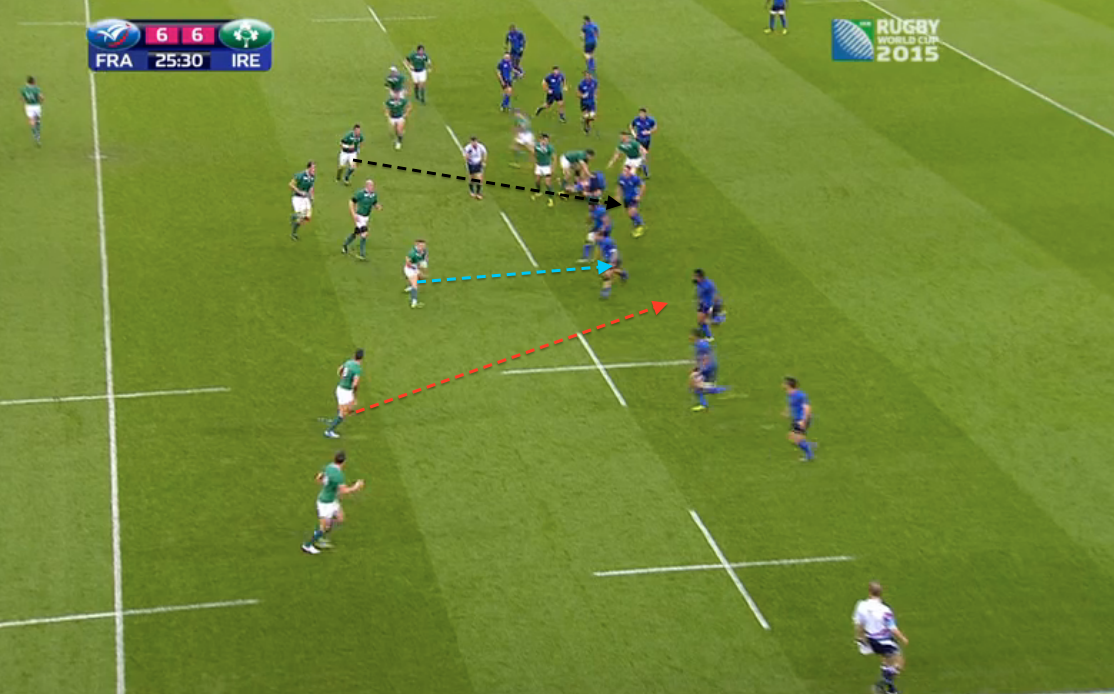
If there’s an obvious overlap, the first receiver will move the ball wide, but if the inside runners go too soon or the defence come up too quickly, he will take it himself. The most profitable option, however, is often to pass inside to the player on the black line.
The reason for this is that fringe defenders tend to be desperate to push laterally across the pitch, leaving a big gap next to the breakdown. Look at this in the next game you watch – the guards will always be behind the other defenders in line speed, because they have had to check their run in order to stop the scrum half from sniping himself.
When you consider just how successful Ireland have been using this tactic, it’s amazing that more teams aren’t also doing it.
By Sam Larner (@SamLStandsUp)
Photo by: Patrick Khachfe / Onside Images
A ? Why don’t England do what Oz did to them as in the above move?
Also as I recall, Oz moved the ball left 1st before thus drawing the English attention in that direction, before then rapidly running it right with Beale & Foley tracking each other & exchanging passes for the try. Farrell’s fault? His man scored.. x2!
Great analysis – enjoyed reading it.