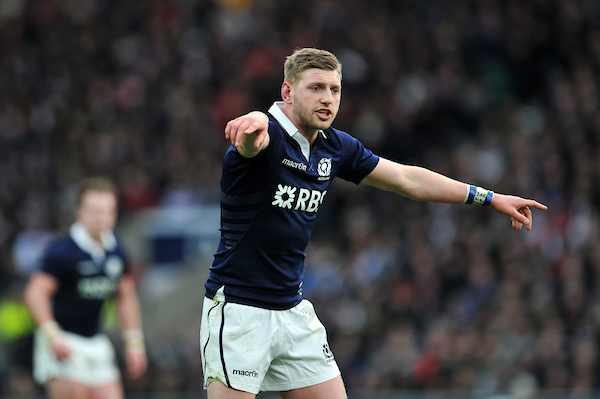
Scotland finished off the dessert of their autumn three course meal with a comfortable win against an improving but overmatched Georgia side on Saturday. They now retire to loosen their waistband for a couple of months before an imposing looking fixture against the new darlings of the Northern Hemisphere, Ireland.
Autumn is the traditional season of hope in Scottish rugby. Too often in the last decade fans have often been nourished by plucky defeats against superior opposition and the odd upset of second string sides from the southern hemisphere only to suffer the famine of another miserable Six Nations.
Scotland have only won the opening fixture of the Championship once since the turn of the century, so what positives can Vern Cotter take forward from the last three weeks and what does he need to work on to make sure his reign as Scotland coach doesn’t fizzle out with the traditional spring let down.
Positives
Unlike some previous Scotland teams, this group of players instinctively want to attack the opposition and critically they have the skills to do so. Everybody is comfortable with ball in hand, support lines are good so players making breaks can keep the ball alive and the outside backs have a cutting edge. 10 tries in 3 games is a more than respectable return, it’s one more than Wales scored in 4 matches this autumn. If the forwards can win the ball, Laidlaw will put them in the right areas of the pitch and Finn Russell can vary his game to attack the best of defences. The centres have finally started to create some space and we have known for some time that the Back 3 are world class finishers.
Faced with some serious scrummaging opposition without your first choice props seemed likely to undermine progress 4 weeks ago but Cotter has managed to unearth some bright young prospects in the shape of Dell and Fagerson. Young Zander’s progress to the top table has been predicted for the last 18 months or so and his performance against Leicester in the Champions Cup last month suggested he was ready for bigger things but Dell’s performances have come completely out of the blue. For the last couple of years he has hardly sniffed the Edinburgh 1st XV outside the international windows but the former Baby Bokke has looked pretty comfortable, if anything Fagerson has been under more pressure. The return of the much vaunted WP Nel and the criminally undervalued Alasdair Dickinson for the Six Nations will be a great comfort but the increased depth will at least mean Scotland fans won’t have to face the less than appealing prospect of Moray Low trotting on after 60 mins.
Fagerson and Dell performed well and Watson looked completely at home in the international arena but it was the fourth newcomer that made the biggest impact despite only playing in the first two matches. The Scots-born, English-raised, Welsh-sounding Huw Jones from South Africa burst on Finn’s chip ahead and into the Murrayfield crowd’s affections with his first touch of the ball and went on to score another with an excellent outside break that left the Australian defence floundering. Apparently his agent has suggested that he will be playing for the Stromers (Western Province to readers of a certain vintage and more extensive experience) in Super Rugby. It seems more likely that he will be In Scotland colours for most of February and March, assuming he recovers from his foot injury.
The final positive is that the belief in the squad seems to have grown visibly over the past year. The agonising nature of the quarter-final defeat to Australia just over a year ago obscured the fact that Scotland were bloody lucky to still be in the game after 78 minutes. It took a nightmare kicking performance from Foley, a defensive brain fart for the Horne try and an intercept try to give Laidlaw’s men the lead before Craig Joubert settled the encounter (I am still more annoyed about the lack of a penalty for the late charge on Hogg than I am about him missing a faint touch of an Australian shoulder as the ball was bouncing around). This year Scotland were clearly the better team in the return fixture, calmly ground out a result over a decent Argentina team and dealt comfortably with the tag of favourites as they avoided the potential banana skin against Georgia.
Negatives
It was better in the third game but Scotland’s complete inability to win possession at re-starts (kicking or receiving) in the first two games fatally undermined the attempt to relieve pressure on themselves or build pressure on the opposition. It really should not be this difficult but opposing coaches are going to be licking their lips until or unless Cotter manages to find a way to organise his team to catch, drive and clear the ball beyond half way. At times against Argentina they looked like an under 13s team on a freezing Sunday morning.
There are some areas of the team with decent looking depth perhaps now including the front row but there are still some positions where Scotland are painfully thin. Injuries to Laidlaw, Hogg or in particular Finn Russell would potentially undermine the whole team and no human alive could replace Jonny Gray’s work rate. Two close games and the need to secure World Rugby ranking points meant that opportunities to develop alternatives in these key positions were limited. Hopefully that won’t come back to bite Scotland in the spring.
It looks likely that wins against Italy and Wales would be enough to secure the critical top 8 place in the draw for the 2020 World Cup but in order to show progress before the coach departs to the sunnier climes of Montpelier, Cotter’s side needs to target a minimum of 3 wins. That doesn’t sound like too much to hope for but Scotland fans already know that it’s not the despair that kills you, it’s the hope.
By Steve Smith
Photo by: Patrick Khachfe / Onside Images
Good summary, thanks. At the risk of showing hope (which I can’t help), I think winning our three home games this 6N is do-able as long as 1) the fellas believe that they can win, 2) our key players are injury-free, and 3) we get a friendly or at least neutral referee. The last point was the difference between winning and losing the majority of the games at this year’s 6N: we got the decisions against France, overcame the decisions against Italy, were barred from competing at the breakdown against Ireland (and Dunbar was YCed for an offence that Laidlaw was the victim of prior to Scotland’s first YC against Italy) and lost to Wales owing to an incorrectly awarded try. I feel like in the summer tour and the AIs we appeared to get the benefit of the doubt or at least something approaching neutrality, so if that continues I think the first point is covered, so it’s just a case of Nel et al. staying injury-free!
Dammit, I’m starting to hope. This can only end badly.
Thanks for the feedback TeamCam
Speaking as a (very) occasional referee, I would like to say referees do the best they can, they are human too, dodgy decision tend to even out over the course of a match etc etc….
What I actually think tends to happen is that referees (like all of us)can have an expectation of what they think they will see and this works against smaller nations (Tier 2s suffer even worse than Scotland). When a world class jackal like Pocock, McCaw etc are over the ball I think referees can be subtly influenced by their reputation and imagine that they are being held up by some magical power. When a less heralded player is able to do the same thing then they must not be supporting their own weight. Penalty for playing the ball off his feet.
I think you’re right: as much as some people like to allege corruption or intentional bias, I think most people actually just want to do a good job, and I’m happy to concede that it’s a job that I’d be unable to do, especially in a fatigued state after running around for 70 minutes! I do think some referees are just bad at it, though. There’s a really interesting HBR article (‘Noise: How to Overcome the High, Hidden Cost of Inconsistent Decision Making’) in which they state:
“High skill develops in chess and driving through years of practice in a predictable environment, in which actions are followed by feedback that is both immediate and clear. Unfortunately, few professionals operate in such a world. In most jobs people learn to make judgments by hearing managers and colleagues explain and criticize—a much less reliable source of knowledge than learning from one’s mistakes. Long experience on a job always increases people’s confidence in their judgments, but in the absence of rapid feedback, confidence is no guarantee of either accuracy or consensus.”
I think that explanation applies to refereeing and helps us understand part of why it’s such a tough job and why the standards are so inconsistent.
Not sure the last time I saw an HBR article referenced on a Rugby blog but thanks for flagging it up, it certainly applies to refereeing (and my day job) but I would say that referees (certainly at my level) definitely get quick, honest feedback.
I was completely unprepared for the level of frankly brutal feedback a referee can expect whenever he is assessed. After my first match as a referee in horrendous conditions I was physically, intellectually and emotionally knackered, far worse than any match I played in. I retired to the bar and had almost every decision I had made broken down and criticized in detail by my assessor. I honestly can’t remember ever having a bigger blow to my ego (Bear in mind I have been married for 20 years!) and this after a match that I had thought went reasonably well.
Sounds hardcore. Presumably they do that, but in greater detail, with the top refs, which begs the question of why Peyper, Lacey et al. are of such a lower standard than Owens et al..
Sorry to hear that you’ve been married for 20 years. That must be very tough!
Owens makes plenty of “mistakes” too but his mistakes are in a particular direction, he wants to see open rugby so when he gets something wrong it is usually in an effort to encourage open play. The fact that he obviously loves the job and gets on with the players helps too.
ps Its not so bad, It was my wife that really got me deeply into Rugby in the first place
The interesting question is why so many of the officials that have come through have been Irish. Assuming that refereeing “talent” is equally spread geographically, what is it about the Irish development system that enables a disproportionate number of them to achieve international status?
There are only really two options, either the Irish system is better at identifying and developing talent or it is easier to achieve international status in Ireland compared to other countries.
Good summary of where Scotland currently are. Think we could be in for a good Six Nations campaign if everyone can stay fit.
Interesting to see that they’ve introduced bonus points to the Six Nations for next year as a trial. Will hopefully bring Scotland up the table a bit as we do seem to close close games quite a lot, extra couple of losing bonus points in them!
On that subject, thought it might be interesting to work out how bonus points would affect the outcome of the last couple of seasons (excuse dodgy formatting):
2015
old new
Ire 8 17
Eng 8 18
Wal 8 18
Fra 4 8
Ita 2 4
Sco 0 2
2016
old new
Eng 10 24
Wal 7 16
Ire 5 13
Sco 4 10
Fra 4 8
Ita 0 1
Not much difference, although Ireland lose out in 2015 and Scotland get 4th to themselves in 2016!