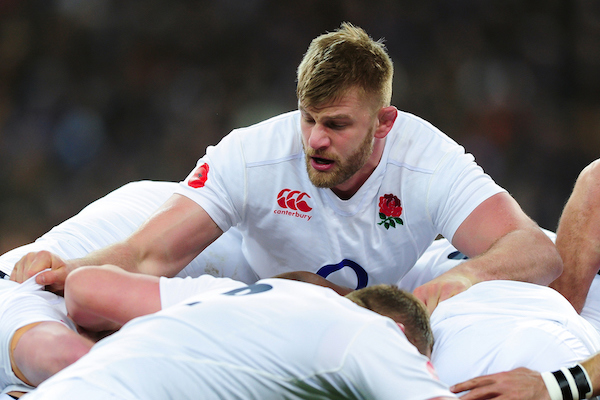
England strangle Argentina, despite early red
England are now one game from making it a winning 2016. They held off Argentina with only 14 men for most of the match, going on to win 27-14. It was arguably the most important win in Eddie Jones’ twelve matches so far. From the fourth minute, England were up against it after Elliot Daly rightfully saw red. Despite building, then squandering a lead, they had the resolve to close out the game and learn some invaluable lessons, which will help in the years to come.
It started so brightly. Owen Farrell had just put England ahead with a penalty, but immediately took a turn for the worse. Daly, not usually a winger, chased the kick off and clattered Leonardo Senatore in the air, spinning him onto his head and sending him off with concussion. The referee had but one option, leaving England with almost all the match to play with fourteen.
It took a performance different to any other in the autumn to come out of the other side. The red rose completely strangled the game, tackling and pressing Argentina into errors, and making them pay for indiscipline. Farrell, even with his slight radar malfunction on the day, kicked England into a 9-0 lead, then converted a penalty try, awarded for a deliberate knock on when Tom Wood was set to score, to extend the lead further.
It seemed England had weathered the storm, but Argentina hit back with a try either side of half time, when England were down to thirteen after Dan Cole was binned. The first came from Facundo Isa. With the clock well into the red, he barged over, Juan Martin Hernandez converting. Straight after the restart, Santiago Cordero scored a wonder-try to bring his side within two points. Backs to the wall. England then stifled the game again, restricting where Argentina were able to play. Farrell again kicked England into a comfort zone, and then Jonny May used his speed to cruise over and complete the scoring, before controversy ruled again. In the dying stages, Enrique Pieretto stamped on Joe Marler’s head to complete the drama and earn a red card of his own.
Against Australia next week, nothing can be afforded to be given away, and Jones will make sure his charges know this. How galling it would be to be so close to a perfect year and not complete it. All hands on deck and all brains in gear. Next week could be something special.
Ireland secure successful Autumn
Three wins was the benchmark for a successful November on the Emerald Isle, and they have managed just that. It was a to and fro affair, which saw Ireland build a healthy lead, only to go behind, before finally sealing a 27-24 victory.
The start was all Ireland’s. They had all of the play for most of the first half, but it took nearly twenty minutes to get on the board. Paddy Jackson slotted a penalty, and a few minutes later Iain Henderson charged over for a converted score after good work from Keith Earls and Simon Zebo. They approached half time seventeen points to the good due to a Gary Ringrose score, but couldn’t keep the Wallabies pointless, as Dane Haylett-Petty scampered under the sticks. The visitors then scored a try either side of a Jackson penalty to take the lead, and extended it further with a three pointer fro Bernard Foley. It looked as if the green and gold would steal victory, but Earls had the last word with a converted score, which sealed it for his team.
With the Six Nations around the corner, Ireland look in good shape to reclaim the crown they lost last year. The only problem; England, France and Scotland also look good, and Wales have pedigree. It should be wide open.
Wales heap more problems on Coetzee
On paper at least, Wales have had a good Autumn by their standards. They have beaten Japan, Argentina and now South Africa, losing only to Australia. Paper can tell fibs, though. Performances have been well below par. They should have used this as an opportunity to put in a showing against a Springbok team in turmoil. Instead, they laboured to victory, doing only what they needed to.
The first half was diabolical, with Justin Tipuric being the only real shining light. It offered only a battle of the boots, and Leigh Halfpenny came out on top by four penalties to Elton Jantjies’ two. Fortunately, the second half was a bit brighter and served up some tries. Ken Owens got the first, shortly after Halfpenny had extended the advantage off the tee. South Africa reduced the deficit to seven when Uzair Cassiem crossed, but a converted score from the magnificent Tipuric sealed a 27-13 win.
South Africa remain in dire straits, and it looks increasingly likely that Allister Coetzee may pay the price with his job. Whether he is the problem, or if there are deeper rooted problems remain to be seen. For Wales, if they cannot develop a more potent attacking game, they are going to be left behind.
France test Blacks, Scots entertain, Italy crash back down
In contrast to the last time France and New Zealand met, this was an actual contest. The memory of the hammering received by France at the hands of the world champions can now be cast aside, as Les Bleus battled gallantly, but ultimately went down 24-19. The Blacks built a lead, with tries from Israel Dagg, Beauden Barrett and Charlie Faumuina, before Louis Picamoles got one back, and the kicking of Maxime Machenaud and Baptiste Serin keeping the French in contention. Finally, Les Bleus look like they can compete with the best again.
Scotland rounded off a pretty successful Autumn with a six-try, 43-16 victory over Georgia at Rugby Park. Georgia took a surprising early lead, but the Scots came back in style, taking a 31-11 lead into the break. Hampshire Watson got on the scoreboard soon after the restart, and after a second try from Georgian scrum half Vasil Lobzhanidze, Stuart Hogg completed his brace, and Scotland’s tally with a cracker. Georgia need more of these opportunities, and hopefully World Rugby take note and they will come. Scotland, meanwhile, need to compete for the Six Nations title in order to show that the exciting brand of rugby they play has merit.
A week on from their historic victory over South Africa, Italy lost 19-17 to Tonga at the death. Make of that what you will. Backing that result up was integral, but the real test for them will come against the other Six Nations sides. Have they progressed as much as most of the others seem to have done?
Elsewhere, Romania beat Uruguay 36-10, Samoa edged Canada 25-23 and Fiji beat Japan 38-25.
Exeter and Quins rise
Harlequins became only the second team to defeat Bath this season with a one point win at the Stoop. It was back and forth, with the lead changing constantly, but ultimately Tim Swiel’s late penalty was the difference. It sends the Londoners into the top half of the table, and allowed Wasps to overtake Bath into second.
The slow start to the season seems to have subsided in Devon, as the Chiefs ran in seven tries, downing Worcester 57-22, and moved up into fifth position in the table. It was the most impressive performance of the campaign so far, and shows that the Chiefs may yet have something to say about the playoff picture.
It was back to winning ways for Wasps, as they recorded a bonus point in a 34-24 win over Sale. Danny Cipriani got a try against his old side, which saw the Coventrians move back to second in the table.
In the other games, Northampton lost 16-22 to Newcastle, who seem to be enjoying their best season in recent memory, Leicester just about held off Bristol 21-16, and Saracens required a trio of Alex Lozowski penalties in the second half to see off a determined Gloucester 24-20.
Pro12
Whilst not much can be read into the Pro12 this weekend, with so many players missing, there were a number of key results which may shape the season.
Scarlets were one of the main beneficiaries. They demolished Leinster 38-29 in a clash of high flyers. The scoreline was deceiving, as 21 of Leinster’s points came when Scarlets were done with their try scoring. The win means that the Welsh team are in the top four for the first time this season, and look like a serious threat on current form.
Another Welsh side were the other major winners this weekend, with the Ospreys beating Glasgow away, 22-5. The Scots just weren’t at the races, but managed to restrict the visitors to a solitary try before Brian Alainu’uese was red carded, changing the face of the game.
Connacht also beat Cardiff 18-7, Munster thumped Treviso 46-3 and Dragons won against Edinburgh 27-19.
Try of the weekend
Stuart Hogg got a couple of very nice ones against Gerogia, which went to show why he is one of the world’s most entertaining players. However, Santiago Cordero scored an absolute beauty against England at Twickenham, including some sublime handling and support lines, and so steals the award from under Hogg’s nose.
We’ll try to find the video today.
Hero of the weekend
Justin Tipiric set Wales alight at the weekend. In what was a fairly dour game, he was everywhere. Turnovers, a try, hands, tackles, he did everything. It was a poor South Africa side, but it took Wales to raise their game against an opponent they normally struggle with. Tipiric grabbed his side by the scruff of the neck and showed how it should be done.
Villain of the weekend
In terms of horrific action, the stamp by Enrique Pieretto on Joe Marler deserves the award, so I will give it to him.
However, I’d also love to highlight inconsistencies that confuse fans. Particularly, the taking out in the air. Daly deservedly saw red for a horrific challenge, which was exacerbated by the fact Leonardo Senatore landed incredibly badly. Argentina committed the exact same offence on Jonny May, he just so happened to land on his feet. The result? Penalty only. It may be beside the point, but I would make it illegal to jump for the catch, increasing bravery as you would be exposed to the tackle, yet eliminating the danger of being clattered in the air. Either way, until that happens, are we judging on the action, or the consequences?
By Joe Large
Photo by: Patrick Khachfe / Onside Images
‘By Joe Large
width=100%’
This tickled me more than it should have…
Haha! Sorry about that, pressed the wrong button, fixed now.
I could not and would not have had any issues if you had kept it in!
I don’t want to see jumping to catch the ball removed from the game, it creates a great spectacle and is a vital part of the game in my opinion. However, the rules should be based on action/intent and not result. I don’t disagree with Daly’s red, but the rules need to be addressed.
England were good, without ever really threatening to look great. Mays try and Browns almost try were both really good attacking moves, but other than that it was about grinding out a win from being a man down.
We’ll really miss Vunipola next week, I’d bring Hughes in personally as he is the most like for like and has been the most involved in the England camp. He needs to up his game though, as his form this year has been average at best.
Totally agree on the non jumping. It would be a real shame if jumping to catch the ball had to be outlawed.
The outcome should not be the way to judge what punishment is given. Daly showed no intent to injure anyone and was immediately regretful of his actions. It was just bad timing and an instinctive reaction to try and tackle the player. Impossible to change direction that quickly or halt his movement so what is he supposed to do. No-one can say for sure the outcome would not have been the same had he not wrapped his arms but just run into him instead.
The Argentinian tackle was almost exactly the same except that the Argentinian only caught one of May’s legs meaning the other one hit the ground first preventing May from injury. Again no real intent shown, but because May landed safely a penalty was the only punishment. For me this should have been a yellow as he took the player out in the air. How he landed has nothing to do with it, he still took him out in the air!
Disagreed
Outcome is the only way to judge it the tackling player has a duty of care. Daly just stuck his hands in the air instead of grabbing the legs and bring him down safely. May was never in danger of injury from that challenge so a pen is the right decision.
Don’t change the rule just because people don’t understand the decision making process
Daly had no chance of bringing him down safely when he got there as Senatore’s knees were at shoulder height, all he had to grab onto were his shins. What is he supposed to do in that situation? He is watching the ball until the last second and by then it is too late to halt his run. He can not avoid hitting him.
May could have quite easily injured his back or knee when landing but he didn’t. Did the Argentinian player help in bringing May down safely? No he didn’t, he was just more lucky with the timing because May was already on his way down.
Daly had no way of bringing him down safely but he could have done a lot to limit the damage. If he had held on Senatore would have been slowed enough in his descent giving him time to get hands out or tuck his head in. As it was he was lucky to only get a concussion.
Don’t think May was at any risk of injuring his back but could have hurt his knee I suppose. You say lucky with his timing, but timing IS the difference between the two challenges
They were both wreckless (Daly and the Argentine who up-ended May). But it’s a question of timing and how wreckless. May was on his way down, hence being bumped didn’t effect him so much. Senatore was at the top of his jump, the timing was so far off it put him in real danger.
I think we have to be careful not to judge to strongly on the outcome, but still understand the outcome is a direct result of the action. “Taking someone in the air” is quite a general term, it could be half a second early but otherwise a safe tackle (and just merit a penalty) or it could be so mistimed that the “tackler” loses all control and puts a player in serious jeopardy (as Daly did).
I think it’s right the referee can apply two different punishments to the breaking of the same law, dependent on the severity of the offence.
I wasn’t impressed by the Cordero try or Argentina at all, they only managed to break away down the wing due to having a two man advantage, otherwise they were clueless in attack and only able to cope with the english largely due to their numerical advantage. Had we kept fifteen on the field we’d have pasted them!
How on earth is Picamoles try against NZ not try of the week that pass from Serin was sublime.
With a two man advantage running a length of the field try isn’t as impressive
Daly deserved the Red, the Argentinian who took out May deserved a Yellow but was saved by May’s foot touching the floor which is very contentious as did the foot bear May’s weight? no.
Both incidents weren’t malicious but it was a matter of poor timing and really the referees only poor declension in a well marshalled game.
Was pretty happy with the Ireland result, considering they spent over half the match with most of their back line out of position.
To be honest, it was a friend who mentioned that he thought eliminating jumping may be the answer. Initially, I was opposed, however came round to the idea (still to be completely convinced though). You can’t hurdle a tackle, so why can you effectively do so when catching a kick?
Also, the fact you can bring your knees up, or kick your legs out when jumping becomes dangerous. The difference between May and Senatore was only that Senatore had his knees up, whereas May had mostly straight legs. They were both at the top of the jump. Not their fault, but one way of jumping is more dangerous than the other.
As for judging on outcome, I don’t agree. So much comes down to luck, as I mentioned before. If they had jumped differently, the outcome would have been different. The Argentine chap did start to pull out was the only difference in my eyes. Neither was malicious, both were clumsy, Daly was just slightly more clumsy.
I agree that the game seemed to be officiated well, so will refrain from slating the ref. That decision though, was not correct. If Daly’s was a red, the Argentine was yellow minimum.
If jumping was outlawed, there would be no confusion. If you want spectacle of jumping to catch, watch AFL. Outlawing it may also increase bravery, having to put your hands higher, therefore exposing ribs and having more big hits.
As I say, I am not convinced, but it has its merits.
Simply can’t agree that the impact was due to jumping style.
May was halfway back down Senatore was at the peak of his jump so timing was different.
Estelles tried to pull out reducing the impact on May allowing him to fall at a 45 degree angle while Daly ran right under him spinning Senatore like a Catherine wheel then let go and waved his hands in the air as if to say sorry.
They are judged on outcomes because generally the worse the outcome the more the player has screwed the pooch on the tackle.
I completely agree on the different approaches of Daly and Estelles. For me, that was the difference between a red (Daly) and a yellow (Estelles).
I think the jumping technique and style contributed massively to how they fell as well though. As I saw, they were both at the peak (more or less). How May jumped was naturally a lot more stable. As I say, not the jumpers fault at all though, but when safety is concerned, not having your knees already nearly as high as your head is going to help.
Wasn’t sure where to post this but HURRAH common sense has prevailed and the 6N will be moving to the bonus point system with an additional 3 points on offer for completing a grandslam