1. The magic of the cup
On a weekend when the oldest football tournament in the world, the FA Cup, won back many of its old admirers, rugby’s youngest cup gained some new ones. It was a round of shock results and swings this way and that when it came to who would qualify, with Wasps’ magnificent draw with Leinster early on Saturday setting up a nail-biting weekend. For the most part, the rugby was nothing short thrilling with Racing Métro’s astonishing dismantling of Northampton and Glasgow’s injury-defying doggedness at Bath particular highlights. When you put aside whatever gripes you might have with the new European format (which, don’t worry, we will explore more below) it’s tough to remember a more engaging round of pool stage rugby in recent times. Some of the story lines were astonishing – Toulouse failing to qualify having won their first four games, Bath and Wasps doing so despite losing their first two.
2. New Europe, new outlook?
Whether you agree with it or not, the balance of power does appear to have shifted. Of course, we only have one year’s evidence to point to and there’s nothing to say that had the old format still existed the quarter-finalists wouldn’t have been the same, but the fact that seven of the eight quarter-final spots are taken up by English and French clubs will not have escaped the attention of those that bemoaned the shift in power towards those two countries. It is only the second time in the past ten years that no more than one Irish province has made it through to the quarter-finals, and the first time ever there has only been one PRO12 representative, although Glasgow did come within a blade of grass of qualifying at the end. Is it that a more competitive PRO12 is sapping the energy of its participants more than in previous years? Perhaps, but far more important than that is the increasingly warped spending power of the French compared to everyone else, and in particular the PRO12 nations. Answers to that particular conundrum on a postcard.
3. French farce
The French were, of course, one of the main drivers for this new European dawn, and yet it would appear that their attitude to continental competition hasn’t changed much. The new tournament’s quarter-finals feature three French sides with home quarter finals, up from two last year. That only tells one side of the story though, and Castres, and to a lesser extent Montpellier, embody the uglier side of France’s European outlook. Castres in particular have surrendered horribly in a competition whioch they have made anything but “more competitive”, which is ostensibly what the French and English were driving for. They finished on a lower number of game points than even Treviso, the Italian side who are often held up as an example of how huge imbalances ruin the competitiveness of European tournaments. Nobody is trying to argue that Treviso are a better team than Castres, but at least they kept trying until the end. The French side, allied with their compatriots’ collective shrug of the shoulders in the Challenge Cup, proved that if a French side decides they have no chance of qualifying, they simply will not take the competition seriously. It is an abysmal outlook, and one that dogged the old Heineken Cup, too. Sure, the Top 14 is competitive, but that is no excuse and if it happens in future, they should be held accountable.
4. Centres of attention
On a more positive note, there were plenty of performances that point towards a thrilling Six Nations, and never more so than in that perennially talked about area, the midfield. Jamie Roberts was in barnstorming form against Northampton and, poignantly, against a man he could well face in the opening game of the tournament, England’s Luther Burrell. Alex Dunbar and Mark Bennett were consistenly dangerous for Glasgow and could take that lethal partnership to the darker blue of Scotland, while opposite them there was some more positive news for England as Jonathan Joseph showed glimpses of his dangerous form this season. And in Ireland’s corner, there was a reminder from Darren Cave that he still has plenty to offer the men in green. Ironically, the man likely to take Ireland’s 13 shirt, Jared Payne, was playing behind Cave at fullback – but the bona fide centre’s hat-trick won’t have escaped head coach Schmidt’s notice.
5. Changing of the guard
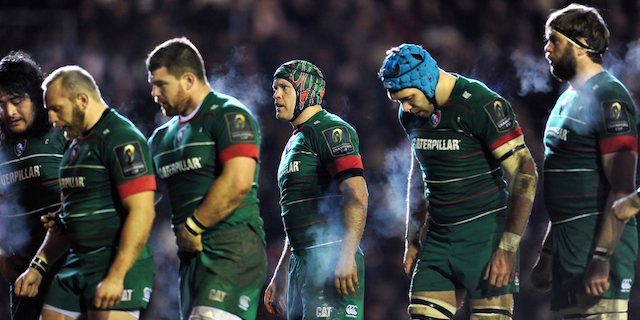
Three of Europe’s biggest names are down and out. Munster, Leicester Tigers and Toulouse have all ruled in Europe and various times over the last 12 years or so, and their respective failures to qualify makes it the first time ever that not even one of them of them have reached the quarter finals. Considering that goes all the way back to the first year of the Heineken Cup in 1995, it is quite some record to fall. Between 2000-2010, one of the three of them made the final every year, and in that time the three sides shared the trophy seven times out of ten. None of them have been at their best in recent years, as the failure of any to reach a subsequent final points to, but to have none of them even in the knockout stages is another matter entirely and points to each side’s real decline. No doubt they will come again, but for now it is a question of rebuilding.
By Jamie Hosie
Follow Jamie on Twitter: @jhosie43
Photo by: Patrick Khachfe / Onside Images
5 replies on “European Rugby Champions Cup Round 6: 5 things we learned”
I’m not sure the new format has much to do with the teams that qualify to the last 8. For example, Munster lost quite convincingly in outings against Saracens and Clermont – what would have been different with there was an extra group elsewhere? They have had a slightly easier group? Even then, if you can not beat two of the sides in your group (when there’s 5 different groups) then you don’t really deserve to be in the last 8 of the competition, whatever its format.
Personally I much prefer the new format, it does feel far more competitive. It use to feel like the group winners plus the groups that were easiest (typically containing Italian clubs) cleaned up the best runner up spots.
Now at least best runner up spots seem more achievable and therefore more games feel competitive.
Would Wasps and Bath have completed their impressive fightbacks if they knew only two runner up spots from 6 groups were up for grabs as opposed to 3 from 5? Maybe that explains those unexpected comebacks.
The French attitude to the Challenge Cup isn’t ideal – but the one flaw in the new format is not giving the winner a Champions Cup place. They should change that asap!
Agree with all of that, but I’m really disappointed in the Challenge Cup. I was hoping interest and coverage would increase as a result of having professional teams from 6N represented. They need to fix that (qualification for the winner being an obvious answer), without doing so I can’t class it as a success (and I was very much an advocate for the change).
It annoys me that everyone is just talking about the French money. The English clubs are buying a lot of expensive players as well and they have more teams in the QFs.
And to your point of French clubs not taking the cup seriously… The MHR played very well and Castres aren’t playing well in the Top 14 either, so…
There is a lot of comments about format of the competition and if that has anything to do with who and who not of qualified. Is it not simply that it is just swings and roundabouts. Good teams come and go and others come on the scene and that is what we are seeing now. The Challenge cup,should Be a stepping stone to championship and in this regard I agree with Jacob. The Challenge cup however, to me is the soccer equivilant of the Europa cup, and ,like the Champions league is a poor relation to the Championship,!
The Challenge Cup winner should get a place in the Chumps cup for their efforts. Anything else belittles the Challenge Cup so why should teams bother too much. Form is cyclical. How many all French finals have there been in the past? One year we had three Irish teams in the semi finals. Leicester and Wasps dominated the competition not so long ago. Now it seems the French turn yet again. The best chance of an English team in this years semi final surely is Bath. Leinster still a bit iffey regarding form. Can anyone see Wasps beating Toulon or Northampton winning in Clermont? Even Racing (who used to be pretty abysmal in previous euro competition) seem to have taken this seriously, they were mightily impressive in trashing Northampton last weekend. Doubt Sarries can turn em over. It also remains to be seen what toll the 6 Nations has on any of the teams.