A week has passed since the ‘new measures’ issued by World Rugby relating to high tackles have come into effect. The law changes increase sanctions for contact with the head. Any ‘reckless’ contact with the head is now, at the minimum, a yellow card (with the amount of force deciding if a red is needed). Any ‘accidental’ contact with the head will be a penalty. The head has always been a no-go area on a rugby field, so this isn’t so much a law change as an escalation in sanctions.
The effect of these changes will be monitored carefully; we should only hold on to these changes if they are good for player welfare. Let’s review what impact the new measures have had so far and look forward to how they may affect the game in the longer term.
Let’s focus on two incidents. Those involving, as unfortunate victims, Geoff Parling and Aled Davies. Both of these resulted in a card; one red and one yellow. Both carded incidents, I think, could have resulted in more severe sanctions. Let’s take the Aled Davies incident.

In times gone by the tackle on Davies wouldn’t have been penalised at all. The Reidy tackle, coming over the shoulder and down onto the chest is not very dangerous. It’s also the only way he could possibly have made the tackle. But under the ‘new measures’ because Reidy’s forearm makes contact with Davies cheek, it’s already a penalty. And because Reidy must have known that he might make contact with the head, it’s reckless and therefore a yellow. That’s fine. The problem with this incident is that there is a second, potentially more dangerous tackle attempt.
Andrew Trimble steps in with a swinging arm which catches Davies squarely in the chops. Does it make contact with the head? Most definitely. Is it reckless? Yes, with his arm swinging like that Trimble can’t be in complete control. So by the letter of the law, it could have been two yellows, but I’m glad it wasn’t.
Now, to the Geoff Parling incident. Out of the two, this was by far the nastier one. As Parling carried into the space between the two defenders, Barritt throws out an arm to try and make the tackle.
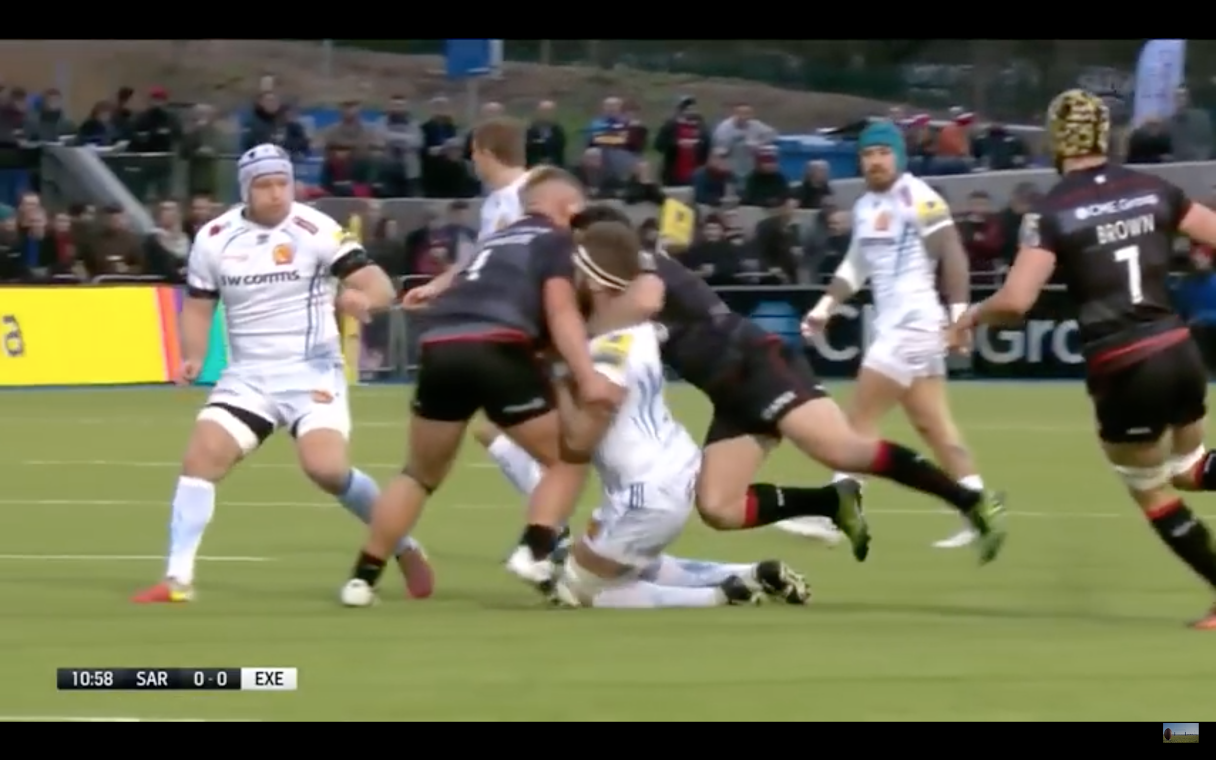
He catches Parling first on the shoulder and *then* slides up onto the head. This is a distinction that used to matter, but under the new law change it isn’t taken into account. As this happens Barrington’s meaty shoulder hits Parling in the face, as he is falling to floor. The way that Parling’s neck snaps back made this really unpleasant to watch.
In my opinion both Barritt and Barrington could have been carded. I think a red for Barritt and a yellow for Barrington would have been appropriate, but as Alex Sanderson said, it “would have killed the game”. Since Saturday an RFU citing commission has let Barrington off and banned Barritt for three weeks. This, I think, is an interesting decision as Barrington’s tackle seemed to be the more forceful of the two. In the view of the commission Barrington was in a position to make a legal tackle, Barritt’s attempted tackle prevented this by ducking Parling’s head right into Barrington’s shoulder. In Barrington’s defence being nearly 20st probably means most things he does are forceful, whether he means them to be or not.
So in one weekend of rugby under the new law changes we have several questionable decisions. As with anything, it may be that the new law changes will take some time to bed in. This could just be an opening blip. But if it does continue like this, one would imagine a clarification from World Rugby is in order. As for the fact that more cards were issued in the Pro 12 than in the Premiership, there are enough factors (such as the referees, the scenarios in the games and human error) that there’s too much statistical noise to properly analyse whether the rules are being applied correctly across the board.
World Rugby have linked this law change with their ongoing attempts to minimise concussion in the game. But with such big men colliding so quickly and with such force, left, right and centre, whether it will do this remains to be seen. Lets take James Haskell’s auspicious return for instance – he was trying to make a perfectly legal, low tackle and still ended up being concussed (72% of HIA’s incidents in the tackle, are on the tackler). Concussions can and will happen even if players tackle lower. So as much as they say this is all about player welfare (concussion) it won’t act in that way.
If World Rugby were to change the game in a way that lead to a lower rate of concussions it would probably have to be something drastic that would reduce the size and weight of the players on the field, such as imposing a weight cap (whether it be by position or for the team as a whole), maybe even extending the length of the game for an extra ten minutes or making the rugby pitch bigger, meaning players wouldn’t be able to carry quite as much poundage. So it would appear to be more of a cosmetic change to the game, removing the horrible, head high shots and replacing them with more palatable, lower tackles.
One thing it may do in the short term is lead to players tackling lower. This tackling technique, once more prevalent in the game, has fallen out of fashion, and this law could bring it back. However, with players having to reacquaint themselves with this tackle technique there may be a period of more concussions. However a lower tackle will lead to the player going to ground quicker, potentially removing the choke tackle from the game, and moving the game back towards a contest on the floor. In the longer term, the game as a whole will hope to assuage doubts over its dangerous nature and that it avoids an NFL-style lawsuit over ex-player head injuries. That lawsuit is going to cost the NFL at least $1 billion. Rugby has taken a pro-active step towards preventing something of the sort whilst protecting player welfare along the way.
On balance, anything that can prevent the nasty injuries that can be caused by head high shots can only be seen as a good thing. But, it strikes me as somewhat of a cosmetic change. This doesn’t have to be a bad thing (it may drive participation and interest in the game) but there may be other, better, ways to prevent concussions from occurring.
By Angus Williams
As an add-on to this article, Wayne Barnes on BT Sport this week provides the referees’ viewpoint, which is worth a watch.
Good to see Barnsey give his view on things and nice to see talk of common sense and spirit of the law, as too often these days its trial by Twitter and hangmans jury the moment a player offends for both the player and the ref
In the Barritt/Barrington tackle it would have been excessive to see two players carded for a single challenge and it would have killed the game
Regardless of who saw the red card and who world rugby has deemed responsible after the fact the sanction on the day was about right. It was a bad challenge worthy of a red card.
BTW thanks for taking my feedback on board with more in depth analysis type articles.
However I would try to release these on Wednesday/Thursday though as they’re the slow news days
Monday – BoTW / Int: Rate the match
Tuesday – Lions SC / Int: Player ratings
Thursday – Int: Team News
Friday – Predictions
Sat/Sun – Watch the games
Yes, that was the plan, but we had a few revisions so couldn’t publish earlier in the week, and didn’t want to wait until next week in case it was out of date!
Can’t promise this level of analysis every week, but I did note your feedback.
I think what makes it difficult for defending players, is that when an attacking player wants to take the ball to ground or dip their body position to help them drive the ball forward, it becomes difficult to tackle them if you’re directly in front of them.
I wonder if we might see attacking players exploiting this by running directly at defenders and dipping into tackles, knowing that the defender probably won’t want to risk making the tackle for fear of penalties or cards.
It should help open the game up a bit, as it will make gang tackles very difficult and make offloads easier.
In the Parling incident, he had already started to dip his body position when Barritt swung his arm in. It was still a swinging arm and should have been at least a penalty or yellow, but as it hit him in the head, that should have been the red. Barrington almost seems to realise at the last minute and panics, probably making it worse than it would’ve been if he’d carried on with his tackle.
Healey (now earning a crust as a commentator) has light heartedly gone on record to say that all a rugby player has to do is charge around with an acutely ‘low’ centre of gravity body position and any tackle will immediately result in at least a yellow.
I can see this going down the FOOTBALL road to ruin with players behaving as if they have been shot (already one infamous example to date – Pape).
Poor referees – what a nightmare to adjudicate! Perhaps they could be paid more to do so!
According to a 2004 Telegraph article, top referees earned between £45-55,000 pa. This has certainly gone up since then (but I can’t find any more recent figures). The Mail put ‘Top Premier League referees’ potential salary at up to £100,000 in 2015. And even then they struggle to control the game.
I think the solution is probably giving the referees (or citing commissions) more power against play acting, rather than more cash.
I think you are completely wrong about the Barritt/Barrington incident. The commission got it right. Barritt clearly caught Parling with a swinging arm head shot. Careless and dangerous. Red card. Barrington was already moving to his right and forward to become the secondary tackler when Parling was hit and had absolutely no time to alter his body position or take evasive action. A complete accident and the ref should have used his common sense as the directive suggests. The thing that made it look bad was the continuous slow motion replays which gave the impression that Barrington had options. In real time he obviously didn’t.