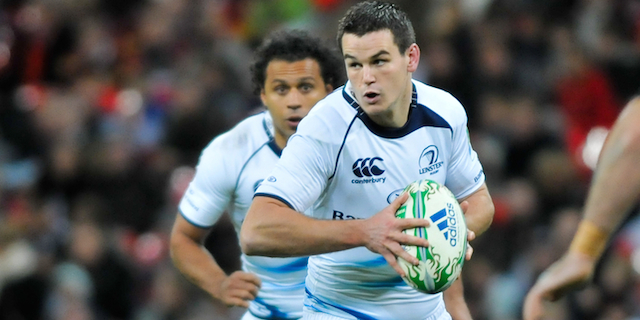
Is there currently a player in world rugby more important to his team than Johnny Sexton is to Ireland?
If there is, I certainly can’t think of him. Sexton is the embodiment of his coach Joe Schmidt’s game-plan: meticulous preparation before the match followed by flawless execution on the pitch. The Irish out-half is Schmidt’s on-field general, a player with a tactical brain every bit as sharp as his coach’s and a right boot more accurate than any other in the world right now.
On Sunday against England, Schmidt and Sexton made England look decidedly average. This was the same England who had put six tries past Italy and squashed Wales with some tactical excellence of their own on the opening weekend.
Ireland are proving that functionality, when you get it right, trumps beauty. They have played very little rugby this championship (just three tries in three games) but they are the only unbeaten side and, to be honest, no-one has really looked like beating them yet.
Outside Sexton in the back-line, Ireland have five players all of whom have spent chunks of varying time in their career at fullback, meaning they are all hugely adept at taking the high ball. It is therefore no coincidence that the Irish have the highest success rate at winning the ball back from their own kicks, and rely heavily on Sexton’s accuracy which gives them the chance to compete for the ball.
In the wake of O’Driscoll’s retirement, Schmidt has assessed the players available to him and concluded that the best chance Ireland have of winning is to employ this strategy that is heavily reliant on kicking and reclaiming, rather than include players with a bit more devil about them.
The likes of Keith Earls, Luke Fitzgerald and even Luke Marshall were all in the mix in the post-O’Driscoll shake-up, but now it looks highly unlikely any of them will make the starting line-up, barring injury, this side of the World Cup. Even on the bench, Felix Jones, a fullback who can fill in on the wing, is preferred to a more mercurial utility back like Earls or Fitzgerald.
Returning to Sexton and his importance, England only really threatened when the fly-half went off and was replaced by the more exciting, but less precise, Ian Madigan. Madigan does not execute as accurately as Sexton, however, and his first kick, which went out on the full, was proof of this. It allowed England an attacking platform and all of a sudden they were camped on the Irish line, and very nearly scored.
It was the closest they came to getting a try all game, and it came about almost directly because Sexton went off.
This, of course, is the potential flaw in the Schmidt plan. What if Sexton sustains an injury just before the World Cup? None of the Irish deputies – be it Madigan, Ian Keatley or Paddy Jackson – are anywhere near as consistently accurate with their tactical kicking as Sexton. Even one reprieve – like Madigan’s kick out on the full on Sunday – can release the pressure valve and change the game, and against the very best sides that can be enough to turn a win into a loss.
Of course, Conor Murray would be there to help whoever came in, and is a similarly precise tactical kicker, but it is impossible for a scrum-half to control a game in the way a fly-half does, because he cannot see the lay of the land, and appreciate the space, in the same way.
With Schmidt working behind the scenes to pinpoint and negate any opposition weaknesses, and Sexton on the pitch relentlessly stifling them, there’s no reason Ireland can’t win the World Cup. But take the latter half of that equation away, and their chances are significantly reduced. Rarely has a single player been so important to a team’s chances of success.
It’s been far from a vintage tournament so far. If you take England and Italy’s eight try bonanza out of the equation, there has been an average of just over two tries per game in the 2015 Six Nations. Even if you include that game, it’s only three per match.
The Six Nations has never matched its Southern Hemisphere counterpart, the Rugby Championship, for number of tries scored, instead relying on tribalism and more intense rivalries to drum up interest. And that is fine – up to a point. But in this World Cup year, it seems the premium on winning is even higher, and teams are even more loathe to take risks. We all want to see our team win, but can we have a few more tries in the process please?
The wheels are coming off at Bath again. Having lost just twice all season, they’ve won just one of their last five games. They’ve had a tough run of games (losses coming against Leicester, Northampton, Saracens and Exeter) but if you’re going to contend for the title, you can’t afford to put together such a poor run of form, and it’s seen them drop out of the play-off spots for the first time this season.
They have greater squad depth this season and for the majority of it so far, they’ve looked like one of the top two sides. But just as last year, they are beginning to falter at the business end of the season. They will be bolstered by the return of their England contingent at the end of this month, but until then they have to dig deep to ensure they don’t fall away completely.
By Jamie Hosie
Follow Jamie on Twitter: @jhosie43
19 replies on “Sexton and Schmidt proving that functionality trumps beauty”
I think Schmidt’s pragmatism isn’t so much because of the talent available to him as the time he has to work with players and the realities of international rugby. At Leinster, he was able to work with his players on nearly a daily basis over the course of an entire Pro12/European campaign. so he was able to focus on handling skills and backline cohesion. That produced one of the most consistently fluent attacking teams we’ve seen in a long time.
With Ireland, he has a backline of Murray (Munster), Sexton (Racing), Zebo (Munster), Henshaw (Connacht), Payne (Ulster), Bowe (Ulster) and Kearney (Leinster). And they only get together 2 weeks or so before any international window. That’s simply not enough time to get everyone on the same page from an attacking standpoint while simultaneously developing a specific game plan for your opponent. Given the increased importance in international rugby of tactical kicking and playing the right parts of the field (see: New Zealand), it makes total sense that Schmidt would opt for a backline that maximizes Ireland’s ability to gain territory or at least exert pressure through the kicking game.
That wins my Golden Conker for the most sensible post I have seen here in a long time.
DDD
I have to agree with this entirely. I also would like to think that the time needed to practice and implement the more open game plan would be achieved pre world cup (with a longer training camp prior to it).
While i enjoy Jared Payne and I think he is doing a great job especially in defence, my hope would be in the long run for the centre partnership to be something like Olding & Henshaw. That would be very exciting.
Have you ever read Zen and The Art Of Motorcycle Maintenance? Give it a go. The general idea is that perfect function = perfect beauty. So the headline is a non starter. Ireland’s approach and win was beautiful because it was perfectly planned and superbly executed. You don’t need “running rugby” for beauty.
Pearls before swine Brighty!
Has the honour of being the best-selling book rejected by the most publishers ever!!!
DDD
I’d love to read it again. My adolescent self found it inspiring and borderline genius. I fear my much older and cynical self will now summarise it as hippy dippy claptrap.
Re – rereading it. Think Hermann Hesse is the Hippy Dippy stuff that is best not revisited! Although I do remember TAOMM being in the back pockets of some right arses along with Rumblefish! So maybe our younger selves were pretentious arseholes that we wouldn’t want to be associated with!!
Think that leaves it open for a few snipes – wonder who will be the first?
My money is on Don P! Lol!
DDD
“mercurial utility back like Earls or Fitzgerald” – is this “mercurial” a euphemism for “bit crap but can do the odd bit of flash now and then”? Is it James Hook all over again?
Yes I believe 12t used to fit into this category. Now its just an aspiration
Earls fits the that mould.
Fitzgerald however is a class act who has been stuck down by injury too often
I don’t agree with that analysis that Ireland out played England by the coach/number 10 out thinking them. I think the tactics were very good……but England bought about their own down fall by poor discipline giving away easy penalties, not catching a high ball…..for gods sakes they are professional players…….giving Ireland scrums in dangerous positions, and then throwing long on a very attacking lineout….twice and loosing the ball….absolutely shameful……the game could have been very different, along with not actually scoring the two tries they went over the line for.
Eye of the beholder I guess James. One could also say that the idea that England played a tactical blinder against Wales is a massive overstatement and in fact if it wasn’t for the lucky bounce of the kick through, the inability for 3 men to get a grip and tackle a player and the bad luck of Webb’s first box kick in the 2nd half then Wales would have done a number on England.
(interesting aside : some people claim that Fale’s try from the base of the scrum was flukey luck but England’s two tries were awesome and directed skill – cake and eat it in the analysis stakes).
The thing is that you can analyse all rugby matches like that (and I do, believe me – I have no fear of us meeting England again, we’ll compete) but usually these individual moments, that you can argue about going one way or another, are cumulative and underlying them is pressure and quality. Pressure from the dominant team that has the game by the scruff of the neck by virtue of simply playing better than the opposition. This is the case for Ireland and was the case when England met Wales. England didn’t bring about their own downfall – they were forced into penalties, bad decisions and wonky skills execution by the dominant team on the night. You may be able to argue that it was just that night, and next time will be different, (as I do with Wales) but you can’t claim that it was a match that England threw away rather than Ireland won.
Agreed. There really isn’t that much difference right now between England, Ireland and Wales from a talent perspective, so the difference in these games usually come down to small moments. Whether you want to attribute those bounces of the ball to a well-executed game plan by the winning side or silly mistakes/mental errors by the losing side is up to you.
I imagine the truth of it lies somewhere in between…
Brighty, thank you for the Robert M Pirsig reference though, is this a first for this blog to have delved into mid 20th century philosophy, did you ever read the follow-up Lila?
I never did catch the follow up, is it any good? Zen seemed like a classic case of a writer putting his life’s ideas into a debut so I felt like I’d already heard the best of what he had to say. (and yes, I reckon this is the first time this subject has come up on this blog). Lancaster strikes me as the sort of man who’d be trying to find tactical inspiration from Sun Tzu.
I think I read Lila but as you can see from my uncertainty if I did, it really didn’t make an impression on me, unlike TAOMM
Like you, I fear I would scoff were I to read it again
PS – re your comments about Faletau’s try above, whilst it was a fantastic bit of skill, it should have been penalty England for handling in the scrum…
Lots of interesting comments here, really good stuff. Harking back to the original article, the only comment I’d make is that it’s a little harsh on Madigan to criticise him for being imprecise when he’s relatively inexperienced and had only just come on the field. In fact, I can remember Sexton, in the days when he was competing with ROG for the out-half shirt, coming on in a match v Wales (2011 I think), and doing exactly the same thing – and it led directly to a Wales try (An illegal one, incidentally!)
I like the idea of everyone being a full back. Sounds a bit like France in the Eighties when they had two props and six flankers in the forwards.
So the future becomes clear;
9. Foden
10. Goode
11. Brown
12. Daly
13. Tait
14. Watson
15. Pennell
I am missing the pragmatic play of Fitzgerald