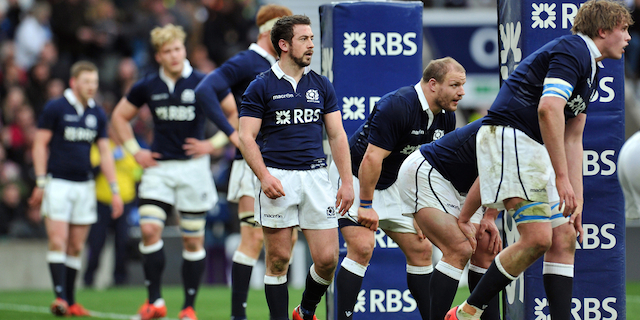
Ireland’s last visit to Murrayfield was a curious affair in which the away side scored only a single try despite making 350 metres with ball in hand through a number of first half line breaks. Scotland, through the kicking of Greig Laidlaw and the contrasting profligacy of Paddy Jackson, pulled themselves back into the match in twenty second half minutes and somehow held on to win. That fixture took place mid-championship in what was a disastrous season for Ireland and a misleadingly good one – in terms of results – for Scotland.
The circumstances of this Saturday’s match are wholly different. Both Championship and Wooden Spoon are at stake. England are Ireland’s most likely rivals, and with the French insipid, uninspiring, and increasingly at ease with mid-table finishes, Scotland away may well be the harder fixture. Behind England on points difference, the Irish have not scored many tries lately, although that is not to say that on a firm, wide track at Murrayfield against a hospitable Scottish defence they won’t fancy their chances.
In a season which has often offered Ireland as genuine big-hitters for this year’s World Cup, it would be unthinkable that they should only win three of five Six Nations matches. Scotland, however, urgently need to prove to themselves and a disenchanted public that they have not entirely forgotten how to win games during their fifteen year malaise.
Scotland
Torn apart in a ghastly first 20 against England, Scotland played with intent, accuracy, and creativity for the second, before submissively accepting what they seemed to consider their destiny after half time. No one could blame them for their surprise at being ahead, but they appeared to sit back.
The principal factor behind their encouraging 20 minute spell was simply that they stopped giving the ball back to England, and in particular stopped giving it back to an incisive England back three in acres of space. Secondly, Greig Laidlaw ran from the base of the ruck to create half-gaps for the forward runners. It is this running game that will be crucial against the Irish, fond of a momentum-sapping choke tackle. The Scottish forwards lack the raw power to carry effectively unless the nine can draw defenders in and create weaker shoulders.
In terms of changes, Adam Ashe returns to start for the first time since November, but in place of Rob Harley at blindside rather than Denton at number eight. Harley’s Six Nations has been quiet by his own standards, and Ashe brings a greater degree of athleticism and ball-carrying, the latter necessary in the wake of Alex Dunbar’s injury. While Alasdair Dickinson has coped relatively well with a serious of unappetising scrummaging assignments, the returning Ryan Grant has real pedigree in the tight and is an effective ball-playing prop. The backline remains the same, and should Bennett and Hogg get enough ball, there should be some entertainment at the very least.
Ireland
Ireland, in control of their first three matches, were hamstrung against Wales by a bad start, meaning they had to chase the game against a possessed Welsh defence. That Ireland were still well in it at the end is impressive, and more so when you consider other contributing factors – an off-colour Sexton, some counterintuitive refereeing from Wayne Barnes, and a frenzied home crowd. The accusation that this Ireland team and their recent style has been found out is off the mark.
At Murrayfield they will, however, be thankful not to have to face either Wales’ asphyxiating defensive press, or Barnes’ interpretation at the breakdown. The back-row of Heaslip, O’Brien and O’Mahony exerts a control on the floor that their Scottish counterparts will find difficult to match. With a different referee and the Scots’ lack of technical accuracy and/or cunning, there should be plenty of turnover ball and possession from penalties. Moreover, the Irish driving maul looked in fine condition in Cardiff, and this is another area of notorious weakness for their opponents on Saturday.
The Irish make two changes, with Cian Healy replacing Jack McGrath at loose head and Luke Fitzgerald, hampered by injuries since 2011, taking the place of Simon Zebo on the wing. The choice of Healy or McGrath is a real luxury. On Fitzgerald’s call-up, Joe Schmidt has said this week that Zebo was less than 100% fit, although it is also true that the Irish style of play in recent times has not allowed his undoubted talent the conditions in which to flourish. Fitzgerald, quick, skilful and solid enough to play regularly at 12 in his early days in the green jersey, will be exuberant on his return. It will be intriguing to see at what stage Ireland open up in search of the desired margin of victory. One also wonders if they have speculated as to what the required margin will be.
All Eyes On
Jared Payne has performed creditably but without showing his range of passing or the gliding outside break that has made him such an effective signing for Ulster, and which almost saw him gain a call up to the All Blacks while at the Auckland Blues. In good conditions, and with Ireland potentially seeking tries, it’s a day for Payne to make a telling impact.
Finn Russell is an excellent prospect and a undoubtedly natural crowd-pleaser. What has been absent in his game is the kind of assured decision-making and accurate execution which invariably characterises the performances of Sexton and Biggar. With national expectations of the team low, this is an opportunity to provide evidence of his progression from innocence to experience.
Prediction
In O’Mahony and O’Brien at the breakdown and the tactical kicking of Sexton and Murray, Ireland have all the experience and talent to stifle the enterprise of the Scottish attack. Playing to these strengths, however, may not provide them with the opportunity to win the tournament itself. Scotland have performed gamely if unsuccessfully this year. They have been competitive in each defeat, but these have surely been emotionally and physically draining. This is contest between two different kinds of desperation, and Ireland’s record in the last year tells you they are unlikely to accept failure. Ireland by 8.
By Charlie King (@CharlescpKing)
Photo by: Patrick Khachfe / Onside Images
12 replies on “Six Nations 2015: Scotland vs Ireland Prediction”
“some counterintuitive refereeing from Wayne Barnes”, “or Barnes’ interpretation at the breakdown”, you could also say that the Irish back row was stifled by a referee willing to correctly apply the rules at the breakdown…
I agree entirely with the prediction, however, I think you may find that a lot of Welsh and neutral fans will differ somewhat on your view of how Wayne Barnes handled the breakdown last weekend and once not allowed to live on or over the line when it cam to contesting on the ground, a lot of the Irish effectiveness was nullified.
Liono, I think that counter-intuitive is a fair description of Barnes’ refereeing, and I don’t believe that it is a criticism.
He enabled the game to be sped up, by awarding penalties. That’s counter-intuitive.
It’s similar to a situation to a few years. New Zealand had a habit of stepping into the scrum, and the whole pack shunting whilst taking small sidesteps. It allowed the scrum to subtly wheel, but wasn’t picked up on for sometime because it was impossible to identify who was the culprit. Turns out it was the whole pack working in unison.
As soon as the referees picked up on it and penalised it, there were a series of games where New Zealand really struggled at scrum time.
Barnes was bang on his money last weekend, and it stifled Ireland’s ability to slow the ball down. Ireland need to be able to win games when under pressure from a referee who doesn’t “like” their style if they are to maintain pressure on the “northern hemisphere” favourites tag going into RWC.
I had ireland by 7 i think it’ll definitely be within the 6-10 range this weekend. They could accomplish more but Scotland should be enough to atleast keep it close.
Basically Ireland will struggle unless they are allowed to cheat like buggery.
Ireland by 23…..it is time for Ireland to let loose and show what they can do…….the title is in the bag!!
This whole debate re Barnes reffing reflects not on Barnes but more on the fact that the powers that be have not sorted the rules – not acceptable for a professional sport.
Re the game, expecting big game from Scots and a narrow win by Ireland.
Pity TV replays weren’t shown (unless I was in the pub dunny @ the time) of those 2 penalties @ the death when Barnes pinged the Irish attack @ crucial times. Still he got himself the desired attention I guess. Boundless WC ambition?
Anyway, Ireland ought to be too strong, esp if they get anywhere near the c. 60% poss/terr they had v Wales. All the same, I don’t see it being that easy as Cotter will determined to get 1 win.
Ireland by, no idea, mug’s game really, but what the hey, 10?
Is Wayne Barnes refereeing anywhere this weekend? I enjoy the Six Nations Rugby but he seems to enjoy his unique idiosyncratic style and even seems to court controversy. There must be several good English referees who can referee better without his need to dominate the game. We lovers of rugby want to see the teams play not to watch Barnes enforce his interpretation of the rules
I don’t understand this idea that Wayne Barnes’s reffing makes for a bad game.
Evidence?
Game of tournament was Wales vs Ireland.
Reason?
Teams forced to run the ball an defend appropriately based on fair calls at the breakdown.
Simple as that.
Will
He’s got a history. Ask the AB’S, Dylan Hartley & the prem player to whom he said; ‘Look @ me when I’m talking to you’! A big head whose ego is more important than the game.
V Ireland he seemed to see what no one else did @ the death? Probably affected the result. Apart from, that he’s a diamond.
Sco Vs Fra – Scotland had a great performance.
Sco Vs Wal – Scotland had another good performance.
Sco Vs Ita – Italy played well but had there not been players on leave for club rugby Scotland would have had a better team.
Sco Vs Eng – Brave performance. England cool and calm.
Sco Vs Ire? People might back either side because of various reasons. I think 10 points max will separate the two sides and it will be a kicking game by Scotland and attacking by Ireland. Ireland by 9.