 IRELAND
What went well
Having benefited from skilful backs for over a decade, Joe Schmidt has brought the contrasting styles of the provinces into a productive union. Many sides have executed a kicking game well and have garnered value from it in the latter stages of a World Cup, but few teams, not even the All Blacks, have nailed the chase in quite the same fashion as the Irish. This is kicking to retain possession rather than to concede it for territory. If ever there was an argument for not specialising in rugby too early, the benefit of Gaelic games to this Irish side provides it. That aside, Sean O’Brien is immovable on the ground and breaks tackles at will. O’Brien alone is changing the perception that the modern 7 is either a fetcher or a ball-carrier, but never both. Paul O’Connell continues to play and lead the side with aplomb.
What didn’t
Ireland have just finished as champions in impossibly tight circumstances against two very good sides, and so all criticisms will be relative. However, it is apparent that the Welsh and their singular focus in defence have an enduring ability to stifle them (see RWC 2011 for more evidence). While Ireland are capable of playing in a number of styles – contrast the asphyxiation of England with the all-court embarrassment of Scotland – they are reliant in all cases on Johnny Sexton, whose coordination of complex back-line plays is just as impressive as his variety and execution with the boot. Sexton, unfortunately, is no stranger to injury or concussion.
 ENGLAND
What went well
Whilst the Lancaster era was constructed on the steady foundations of Robshaw’s ethos and Farrell’s accuracy, the emergence of George Ford and Jonathan Joseph at 10 and 13 provides the materials to win through a greater variety of means. Both are given space by the arcing runs of Ben Youngs, who ran the game against Scotland and France. As a result, it has rained tries at Twickenham this year. What’s more, the English scrum was dominant away in Cardiff, a feat in its own right and particularly impressive given the destruction wrought upon it two years ago. There is no other nation in the northern hemisphere with quite the same strength in depth up-front. The forced selection of the second-choice pairing of Attwood and Kruis made no noticeable difference and both came away with much credit. It was only when Courtney Lawes returned to such notable effect that it was apparent what had been missing.
What didn’t
Luther Burrell made a decent fist of inside centre without nailing the position down. Time means that other options – namely Tuilagi and Barritt – will have little chance for a run of games before the World Cup. More significantly, England never even got close to controlling the game against Ireland, a deficiency which has its roots in an inability to cope with the kick-chase and at ruck-time. Granted, playing against O’Mahony and O’Brien are special circumstances, but for all the graft on show the absence of a genuine breakdown technician amongst Robshaw, Haskell and Vunipola is glaring.
 WALES
WALES
What went well
Much maligned in early February for their brittle performance against England, Wales thawed in the Spring sunshine and ran hot in Rome. The forwards are relentless in defence and at the breakdown, and Sam Warburton finds himself in good form at the right time. In the backs, Scott Williams is an able replacement for Roberts or Davies and, in the minutes he does play, always states a strong case to start ahead of one of them. Liam Williams, meanwhile, is the sort of maverick for which Wales have yearned since the retirement of Shane Williams. Rhys Webb provides a sniping break at nine, and Dan Biggar’s composure goes unquestioned behind the Welsh forwards. There are players of real quality and considerable experience throughout the side, not least among them Alun-Wyn Jones.
What didn’t
That Wales grow into tournaments is of no disastrous consequence in the Six Nations, but is uncomfortable given their World Cup group. They struggle to escape attritional Warrenball in tight games. It is effective in many situations and is an appropriate default for knock-out rugby, but at the same time Wales should be comfortable to play with greater invention when circumstances demand it of them. Trailing after 62 minutes against England, one could see that little progress was being achieved, and there was time left to try something else. That said, a tendency to stick to flawed scripts through ignorance or habit is a failing not just of the Welsh but of the modern professional player in general.
 FRANCE
What went well
The final match at Twickenham provided evidence that French rugby’s elegance had been anaesthetised rather than killed off completely. In particular, we saw their unparalleled ability to run onto the ball at pace, with Maxime Mermoz and Gael Fickou combining to real effect. While Wesley Fofana was injured, it was noticeable that greater fluidity came with Mathieu Bastareaud benched. Noa Nakaitaci adds strength to wing options which already include Yoann Huget and Teddy Thomas. What was also impressive was France’s cloying ability to stay in games, most apparent in Dublin, where they ran the Irish close after a subdued first half. In a tournament which so often provided suggestions to the contrary, it was just enough to sustain belief in the tattered notion that the French should never be written off.
What didn’t
The last game aside, the French effort was dull and lacked conviction. Selection policy continues to resemble that of many amateur sides; a cobbling together of whomever’s available, supplemented by assorted South African ringers. No-one really knows who is going to play, particularly at nine, where Philippe St André used three different players. In light of the historically important role of scrum-halves in shaping how French teams play, this is significant.
 ITALY
ITALY
What went well
Despite years of beatings in this competition, the Italians’ sustained belief in their upward trajectory is something to behold. Sergio Parisse is still going strong and is ever more charismatic with each passing year. His resourceful leadership at Murrayfield made the difference. Luca Morisi and the injured Michele Campagnaro are potent threats at 13, and Andrea Masi still does an admirable job at 12 (or wherever else he happens to be selected). Canine assault forced rotation of the front row and proved that the Italians still possess an admirable strength in that area. The rolling maul was well executed and is one of Italy’s more potent weapons.
What didn’t
The 60-point battering in the final game was partly the consequence of some enterprising Welsh play, partly that of a surrender after four and half games of earnest struggle. Tackling, in particular, left a lot to be desired. Other cracks run deeper. Kelly Haimona, impressive in some ways, is not an international 10. His understudy, Tommy Allan, failed to claim the jersey from him, and Luciano Orquera is a much-tried, oft-abandoned option. Whilst Morisi provided moments of inspiration, Italy’s inability to stay in games is of some concern. This is an Italian side which shares many of the flaws of its predecessors.
 SCOTLAND
What went well
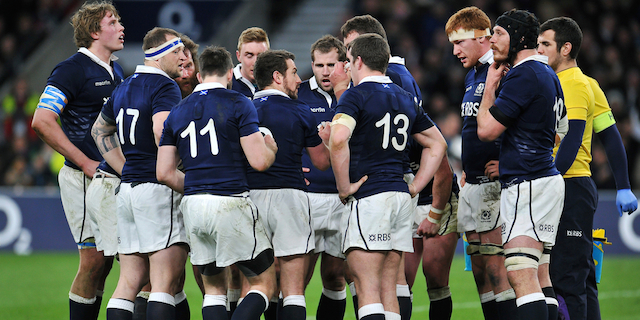
In Dunbar, Bennett and Hogg, Scotland’s 12, 13 and 15 are the equal of any side in the tournament. Dunbar’s injury is a great shame and removes all balance and ballast from the Scottish backline. Hogg is too good for this Scotland team, in his demonstrative desire as much as his elusive running. Bennett provides the wider penetration considered, from about 2007 to 2014, to be the missing piece of the Scottish jigsaw puzzle, although the folly of that belief has now been exposed. Scotland’s backs, particularly Russell, have time on their side by virtue of their youth. If the choice is to be between thrills in defeat or the kind of joyless fare served up for so long, the former will do nicely for now.
What didn’t
There are under 14s sides with a greater ability to hold themselves together under pressure. Some of the tries conceded – Davies vs Wales, Italy’s winning penalty try, Ford vs England, just about all of those scored by Ireland – were terribly soft, and meant bookies like Paddy Power‘s prediction for them to finish rock bottom came to fruition. In the arid years, a national inferiority complex seems to have developed and it could not be shaken in 2015. The Scottish mind aside, the forward pack is composed – with the exception of Jonny Gray and Blair Cowan – of players who are competent at one thing but whose lack of a more rounded skill-set is exposed at this level. Contact skills are poor, and rucking is ineffective in both attack and defence. Discipline was also a problem, with yellow cards in four of five games, but this is a by-product of an inability both to exert and deflect pressure at the breakdown.
Rugby World Cup Prospects
Four of the Six Nations teams have the capacity to go deep into the World Cup. The case for the French may be unconvincing, but that was very much true in 2011. England, Ireland, and Wales deserve such a reputation on the basis of several convincing performances in recent times. There is little to choose between them on any given day. One might argue that what actually matters is an ability to beat southern hemisphere sides, and by that measure perhaps only England and Ireland have genuine credentials. The English, in particular, have an innate confidence that sees them expect to win each game, a belief further strengthened when playing at Twickenham. The concern is that the expansive style of Ford and Joseph is not best suited to the inevitably tight games from the semi finals onwards. Ireland, on the other hand, have worked a game plan over the past year devised for precisely those circumstances. Italy’s progression from the group stage looks unlikely, and Scotland will be nervous against a Samoan side which will have the benefit of time together to prepare.
By Charlie King (@CharlescpKing)
Photo by: Patrick Khachfe / Onside Images