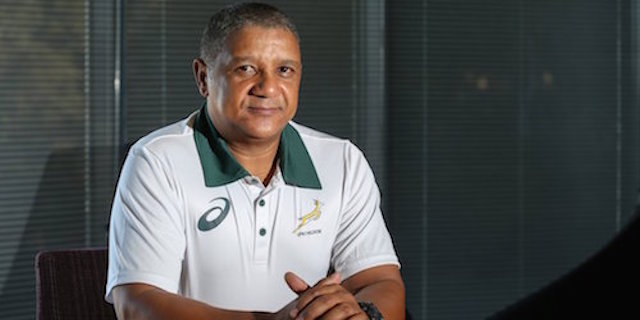
Allister Coetzee was on Tuesday appointed as the new head coach of the Springboks, after a torturous few months in which the South African Rugby Union built up to this big reveal, despite everyone knowing what the outcome would be anyway.
Still, South African rugby fans are almost unique in their passion, so it hasn’t hindered the level of reaction.
In my dual role as editor of this site and content/social media man over on SuperBru (the sports prediction site with a huge South African following), I get a fair amount of exposure to the opinions of Springbok rugby fans. The prevailing wind after this appointment is that Coetzee is a competent, if limited, rugby coach, who will ensure defensive solidity but do little for the Boks’ attacking game.
More importantly than that, however, is the understanding that Coetzee is exactly the right man to implement the government’s transformation plan, whereby the Springbok side is split 50/50 between white players, and players of colour by the 2019 Rugby World Cup.
Ah, sport and politics – when these two meet, there is rarely much joy amongst fans.
Transformation is an admirable goal and one that South African rugby absolutely should be trying to achieve, but is arbitrarily aiming for a 50/50 split by 2019 really the best way to go about it? Should an international, professional sports team not be picked purely on merit?
These are questions that seem logical to outsiders. Bringing politics into team selection is risky, because if the team then goes on to lose, you have created a rod with which to beat your own back – transformation will become an easy target for fan ire when results aren’t going their way. That could get ugly.
There is little doubt, though, that with transformation near the top of the agenda, Coetzee is the right man for the job. The results of his time as head coach at Western Province are there for all to see – the Stormers field more players of colour than any other South African side, and they are one of the most successful sides in the country, too.
Investing money in grassroots schemes to get more youngsters of colour playing rugby is, of course, also of paramount importance, and will eventually have the desired effect of producing more top level players. From the outside looking in, it is easy to argue that this should be allowed to run its course and filter through to the top levels – namely, the Springboks – organically, without setting random targets of X number of players in the team by X time.
Unfortunately for SARU, however, they know they are judged almost entirely on the Springbok team. They have spent R500m (roughly £24million) on development since 1992 – and some strides have certainly been made – but that money means little if change isn’t being seen in the Springbok team by the people that matter.
That, in a nutshell, is why they have implemented a four-year plan, and set four-year targets. Never mind that top level schoolboy rugby is still largely the preserve of certain provinces, while in others it doesn’t even have a presence in a lot of schools. Change needs to be seen to be happening at the top level.
Of course there is another, less cynical, benefit to setting quotas, namely that youngsters can look at the Springbok team and see players of colour succeeding, and feel inspired to try to get there themselves. There’s no point in investing a load of money in the grassroots game if there isn’t a clear pathway to the top. Young players need idols; if the dream doesn’t seem real, no-one will bother chasing it, no matter how much money you invest.
And if you speak to rational South African rugby fans, this is largely where they are at right now. Perception is shifting. Where previously they might have agreed with the sentiments further above – namely that random quotas could harm the effectiveness of the team – there is now a greater openness to try such things.
There is an acceptance that not enough has changed in the recent past and that, in the context of where South Africa is as a country at the moment, maybe everyone needs to get over it and accept that this is going to be a period of difficult transition; that this is about more than just rugby.
Personally, I feel like no international coach should ever pick players on anything other than merit. This is the pinnacle of the sport, and nothing but being the best should let you reach it. But it is easy to say that as an outsider looking into the South African situation, where there is so much more at stake.
When sport and politics meet, there is always the potential for disaster. But in South Africa’s current climate, it is a risk that may just be worth taking. Whatever your view on how transformation should best be implemented, there is little doubt that Allister Coetzee has a very, very difficult job on his hands, to balance the need to win, with the need to hit political targets, all set against the backdrop of the country’s volatile past and uncertain present.
The Springbok coaching job is entirely unique in that sense. The very best of luck to you, Allister.
By Jamie Hosie
Follow Jamie on Twitter: @jhosie43
Really interesting article Jamie especially for those of us less exposed to the politics etc of rugby outside of this little island! One thing though, you didn’t mention anything about Allister Coetzee’s assistants and how they would be contributing to the setup?
Jamie, a brave yet balanced article. Good to see that you have been forthright in your opinion also. A subject that raises so many questions and so many issues on all manner of levels.
The SA football team is pretty much always 11 black players yet for some reason there is no race involed in those decisions…interesting to me. The whole race issue is the main reason SA have no chance of ever touching the AB’s and will always have to settle for second at best.
Yes that is very true but kinda missing the point
The issue is that there should be no barriers to stop someone with the talent and the desire from representing their country at their chosen sport. With football no such barriers exist to stop a White player from being a professional footballer other than their own opinions of the sport.
While with rugby there is not sufficient provision and access to the sport at the grassroots level outside of predominately white communities/schools
The problem with introducing a quota is that it does nothing to address that underlying root cause and therefore is destined to fail
Good article.
Won’t the idea of a quota that results in players being chosen for the colour of their skin rather than their ability be self-defeating? The best way to drive the popularity of a sport is through success. No-one will want to be a Springbok if they are perennial losers.
A quota and a poor team may lead to a disaster on two fronts. A decline in popularity or desire to play for the national team amongst the white kids who might see lesser players being chosen ahead of them. And a lack of popularity amongst coloured kids, who whilst they may see more people like them being selected, may also see those same players failing at the top level because they’ve been selected for a political reason rather than due to their ability.
I think quotas are almost without exception a bad idea. Those who aren’t selected will be bitter as they will assume that anyone picked ahead of them is only there for a political reason, even if that is not the case. And those who are selected will question whether they are good enough or just there because they fit a target.
It leads to resentment and a lack of trust
In this case, I would also imagine it will result in a fresh influx of young South African rugby players coming to Europe
I might be missing something, but I don’t see quotas mentioned in this article – only a target of a 50/50 split (probably best not to think about the 15th man).
Having a target certainly isn’t a bad thing, but as others have pointed out, the problems are much lower down so will take time to filter up and 5 years sounds a bit too short a time.
It’s a matchday squad so its the 23rd man you should be looking out for :-)
It’s definately a quota rather than a target and is already in place with 7 members of a matchday squad required to be of colour and 5 on the pitch at anyone time. What they are talking about is increasing the ratios by 2019
More info here:
http://en.espn.co.uk/southafrica/rugby/story/240477.html
http://www.stuff.co.nz/sport/rugby/international/10480265/Colour-quotas-loom-for-South-African-rugby
Its an impossible subject to answer in my opinion with so many questions that often defy logic. Perhaps not growing up or living in SA makes their reasonably unique case in history impossible to understand from your won perspective. However this does not stop me offering my two rands worth. Take the case of the recent cricket tour of South Africa by England. The SA cricket team is also bound by similar quota systems although I dont think they enforce a 50/50 ratio. Would Bavuma and especially Rabada, two black saffers who are young and apparent quota players both ended up being the best players for South Africa. Would they have been given a chance without the quota? How do you think they feel representing their country (which I can only imagine being difficult enough) walking into the dressing room, perhaps thinking whether they have justified their selection or whether they have just been picked under the quota.Why did Luke Watson used to count as a non-white even though he is white because he was outspoken against Afrikaners and his fathers political record? Do selectors in SA favour a white player over a non-white even if they are exactly the same player in terms of style, skill etc? Doesnt the point of picking non whites to encourage young non whites cause exactly what they are trying to discourage? i.e. differentiating between colour of players representing the same country? In short, I do not and perhaps will never know.
Pablito, I think you make a great point re fresh influx although all teams have benefited from SA players over the years (and not just rugby), even the All blacks (I can only think of one – Rawlinson) but hopefully point made. I wonder how many of these if truthfully asked whether it was politics that pushed them along to representing another country of their birth they would answer yes..
In any sport there are only winners and losers. Winners are remembered, losers soon forgotten.
Winning teams attract huge sponsorship, losing teams like the Kings often face financial disaster and cannot meet their financial commitments.
Winning teams attract better players and bigger crowds,The Lions support weaned over the years
but now that they are back on winning ways ,record crowd attendance of 41 600 at Emirates Airline Park was reported for the Lions-Stormers clash.
If you now impose a 50/50 quota on teams like the Lions they will soon find themselves on the losing path again and face the same dire financial straits as the Kings and slide backwards on the log.
In any sport merit is all that counts on all levels and the colour of your skin
Quotas are a total nonsense.
We’ve got to take X number of Scots on the 2013 Lions Tour because…….
We cannot put Ian Evans of the bench for the 3rd test v Aus because we’ve picked so many Welsh players as it is.
We cannot drop that Irish centre for the 3rd test because Keith Wood and co will get upset.
As Wilf Wooller used to say ‘Keep politics out of sport’
What idiot proposes a 50% quota in rugby when the population it is supposed to help prefers foot-all and we see video evidence of the SA nation’s current president that goes around singing
‘Get me my machine gun..Shoot the Boer..Kill the Boer’ with thousands of ANC supporters all joining in.
One quota the Liberal Fascists and Guardian readers conveniently forget is that more White South Africans have been murdered/raped/robbed/burgled by Black South Africans than the other way round.
The number 1 group in SA society that kills the most Black South Africans is……
Other Black South Africans.