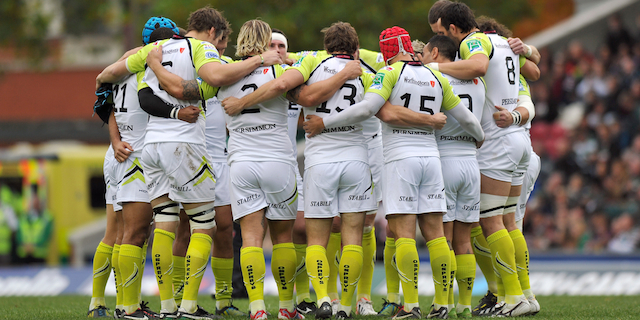
One of the cruelest parts of sport, and one as attritional as rugby in particular, is the propensity for quality players to be cut down in their prime through repeated injuries. For many, it becomes too much and they retire, either because they cannot face the agony of rehab yet again, or because medically it is simply unsafe.
Eli Walker will not be one of these players. The Ospreys winger has had a torrid time with injuries, tearing his hamstring twice last season to keep him out for the majority of the year.
The young Welshman captured the imagination of the rugby public almost two years ago now when he decimated the defences of European heavyweights Leicester and Toulouse in the Heineken Cup group stages. Speaking to him now, it’s apparent he never lost his desire to return to the game despite so many setbacks.
“It was never in mind – there was never a doubt,” he says. “It was just a case of how long it would take. I’ve had a long time to recover.”
A hamstring strain is not the most serious of injuries – think of Pat McCabe’s repeated concussions or Tom Croft’s broken neck – and Walker admits as much.
“Personally, I’ve never heard of retiring from a hamstring strain! They are quite superficial injuries. I suppose in my position it might be a bit harder on the mind, because I am a runner so the hamstring’s a big part in that. But no, there was never a doubt in my mind that I’d come back playing.”
That said, it does take considerable mental grit to come back from such a rotten run of injuries, no matter where they hit you. He tore his hamstring for the first time just before the start of last season’s Autumn Internationals, then did the exact same thing on his first game back three months later.
Walker admits that the lack of lag time between suffering the same injury did make him a little more conscious of the possibility of getting injured when he returned to action last Friday night against Treviso.
“I’ve had my fair share of injuries already in my career, and initially the first few games back I never did think of them. But this particular one, because it happened twice on the bounce, was a little bit different. I have been wary about it in pre season and it is in the back of my mind sometimes going into the game.
“There’s not really much more I can do. I’ve done all the rehab that I can and I’m set to play now, so given time I’ll just get a bit more comfortable.”
Ospreys fans will certainly be hoping so. They’ve had a fairly torrid summer, waving sadly goodbye to several club legends as the Welsh game fell deeper into the mire. It looks to be on its way back to recovery now, but of all the regions the Ospreys were probably the biggest losers from the seemingly never-ending civil war.
Obviously, Walker is looking to the positives and sees it as a great chance for youngsters to break through and get more game time – as he himself did a short time ago.
“It’s quite difficult with high profile players leaving,” he says. “I suppose you can’t replace them, but it’s a chance for youngsters to come through. When I was coing in we had huge strength in depth.
“It got a bit quieter over the past couple of seasons, but we’ve backed that up with youngsters so we’ve got a good group and set-up and there’s no doubt in my mind that we’re going to have decent campaign this season.”
Walker is exactly the type of player who, if he remains fit, can make sure the Ospreys punch above their weight this year. The kind of guy who can elevate a team from mid-table mediocrity to challenging for the play-offs. A game changer.
Sadly, he is an example of what is becoming a dying breed. When you look at the sheer size of a lot of modern wingers (and the Welsh national side is perhaps the best example of this), there is an increasing worry that players of Walker’s ilk won’t be around for much longer. Consider his injury troubles in the past few seasons, and those of perhaps his closest counterpart in England, Christian Wade.
“The game is changing, and players are getting bigger, there’s no doubt about that,” Walker accepts. “There’s a lot of different aspects to the game – the bigger guys are powerful runners getting over the gain line, but I think you need a bit of finesse and a bit of footwork to compliment that as well.
“Luckily in my position, there are two wings – at the Ospreys they like that variety of having a power based winger and more of a finesse finisher, a game-changer type of player as well. There are two wings on the pitch, and I do think there will always be a place for the smaller, quicker guy.”
Whether Warren Gatland sees it that way is another matter, but for entertainment’s sake, let’s hope Walker’s right.
By Jamie Hosie
Follow Jamie on Twitter: @jhosie43
 As you know by now, we are hilarious, and you should be following us on Facebook and Twitter.