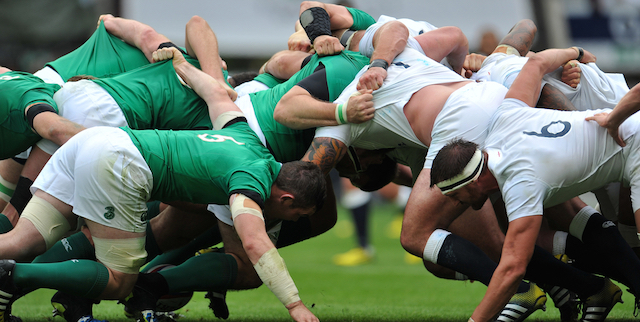
One of the great scourges of the modern game is the endless scrum reset. We’re all familiar with the process – the clock ticks on as front rows fold into the turf and the referee seemingly endlessly blows his whistle and holds out his arm for a reset.
More often than not, this either leads to a penalty, or for the referee to simply ignore the latest collapse and wave play on, as he senses the crowd’s frustration. It has become something of a lottery.
So why don’t we stop the clock during scrums, and restart them when the ball is at the number eight’s feet or in the scrum-half’s hands again? I genuinely cannot think of a reason as to why this is not a good idea.
The scrum is clearly an integral part of the game of rugby union, and it must remain that way. It is a unique contest of power and technique and when done correctly, it can be great to watch (and that’s coming from a back). But too often these days it is a mess, and that mess should not be sorted out at the expense of game time.
Stopping the clock during the scrum would lead to higher ball-in-play time during matches. That would mean players have to be fitter, as they have to spend longer chasing the ball around the park. It may even see a decrease in player size as a result – something that will be increasingly discussed in coming years, I think, if there continues to be so many head injuries.
It would also take the pressure of referees somewhat. The ‘dark arts’ of the front row are much spoken of, and to be honest, it does feel like referees sometimes are forced into a bit of guesswork at which way a penalty should be given. If there was no pressure from the clock to get the game started again, then they could take their time to get the decision right.
It might lead to scrums taking a bit longer, but ultimately I think that would be accepted by fans if the clock were stopped, and it might bring to an end the perceived lottery of penalties that goes on at the moment.
The only downside might be that matches go on even longer than they already do, with many stretching over two hours these days. My solution for that would be to cut the TMO’s remit down in some way – the majority of “time off” currently is for the man in the van to butt in and have a look at endless replays of something that happened eight phases ago. Let’s get rid of that and use the time to sort the scrums out properly.
To be honest, I can’t see it being something that is adopted any time soon – World Rugby seems to be too preoccupied with trialling nine point tries, and other such madness. But what do you think? Vote in our poll below and leave your thoughts in the comments section.
 Loading ...
By Jamie Hosie
Follow Jamie on Twitter: @jhosie43
Photo by: Patrick Khachfe / Onside Images
 As you know by now, we are hilarious, and you should be following us on Facebook and Twitter.
I have often pondered the same issue. However, there are too many ‘cons’ to the ‘pros’ outlined above.
Firstly, the physical effort put in by those scrummaging will end up being more than the allotted 80 minutes, as there will be a huge amount of work going on when the clock is stopped.
And, secondly, should a team lose a scrum against the head, at what stage does the clock start again?
Agree. Another point to consider is if the attacking team get the nudge and are able to make yards with the ball at 8 trundling forwards. When does the clock start? If they nudge but then are stopped does the clock stop again?
I don’t think the physical effort needed is necessarily a con, as the front row rarely finish the 80 minutes on the pitch these days anyway. It’s a 23 man game, and the front row replacements are amongst the most important.
Scrum against the head – the clock can start whenever the ball comes out, no matter which side it is on. It won’t necessarily be an exact science, but perhaps the moment the scrum-half (from either side) has the ball in his hands, then the clock starts again, as that is the moment when the ball has actually left the set piece.
I appreciate there are likely lots of niche laws that mean this can probably never happen, I’ve just become so exasperated by scrum resets I thought it was time to gauge people’s thoughts!
Have World Rugby arrange for Nigel Owens et al to visit a veteran prop from a grass roots rugby club that knows all the dirty little tricks (which include scrum collapsing) and ask him to give them a master class on who exactly is doing what to the other, how, and why.
Arrange for the shirts to not be so darned tight so that opposing props can actually get a decent bind on each other’s shirts. Half the cards seen for slipped binding aren’t for anything sinister, but actually because a prop can’t bind onto the shirt.
Removing at least half of the pre-amble prior to engage; it’s a lot of weight to hold in an awkward position at one point without it being drawn out by referees who are (understandably) keen to be seen as doing their job correctly, you effectively go from a strong position to a weaker one the more time draws on. If the binding issue above is resolved you don’t need that much time to get settled and if you aren’t settled or ready when the referee begins said pre-amble, guess what? You can stand and reset, so actually no real issue with not being able to get your bind in time.
+1 or “like” or whatever the missing function here would be if it existed.
If scrum halves are made to put the ball in straight, currently ignored but for some reason crooked throws at line out are strictly policed, then both hookers have a chance and will have to strike so focus will necessarily change to winning the ball not a penalty. Scrum penalties between 10 yard lines should become free kicks, possibly between 22metre lines?
Brian Moore made this comment during England vs France. Either we ditch the requirement to have the ball put in straight or we keep the law and police it. In the same game, we saw how top level teams could successfully contest line outs when the ball was put in straight so why not the scrum. The current system means that there’s little by way of contest at the scrum other than the bind and shove. Surely adding another variable would add both to the game and the spectacle. I for one would love to see hookers trying to beat each other to the strike again – when was the last time you saw a free kick given for foot up at international level?
Add to that, the law still exists that you are not allowed to push before before the ball is put into the scrum. That, together with the straight feed and foot-up would solve the scrum problem and put it back to a means of re-starting the game and an opportunity to win the ball.
Stop Flankers getting involved in the front rows work, I’m not sure if anyone else saw this in the England V Ireland game where I think Mako bound quite a long way down the body his opposite number, the flanker noticed and punched his arm away, the scrum collapsed and England got pinging.
In my eyes this was foul play on the Irish players behalf and the penalty shoud’ve gone England’s way.
I think the clock should be stopped until the ball is put into the scrum and stopped if it goes down or the ball goes through the scrum and I agree with the crooked feed comment by Bazzaboy.
I think the time should be left on but only stopped if the scrum goes down. As soon as the first whistle goes the referee turns the clock off. That way, if the scrum stays up and gets completed first time, then you just carry on playing as normal. Each scrum will then only take “one scrums length” unit of time. Stopping the clock before the scrum almost accepts that is going to be a problem, a bit more optimism would be nice!
Fair point, agree when you put it like that.
+1 from me. The scrum itself is an integral part of the game. It’s the reset process that needs taking out of the 80 mins.
For me its a no, The issue isn’t with the clock.
The main issue is that, because of crooked feeds, there is no competition for the ball. This means that the team with the ball can then try and milk a penalty. Instead of competing for the ball teams are too busy trying to compete for the penalty.
Enforce the rules on straight feeds to allow fair competition = hookers to learn how to hook again = team with ball will be focused on retaining the ballnot milking a pen
Refs to shout use it once it is at the back foot to get play going again
also
stop the clock = longer games but
stop the clock fitter/leaner players
The backs can now have even longer to stand around and catch their breath between plays while the forwards push each other about, therefore they can afford to get bigger not smaller.
The forwards still need to push but not run around during the clock stoppages yet again this will lead to them getting bigger/stronger not leaner/more athletic.
Don’t necessarily agree with all of that. Firstly, I don’t think straight feeds would stop this issue. Other than the initial hook, the rest of the scrum would be exactly the same (except slightly less shoving from the guy wearing the 2 shirt).
Also, if forwards are spending more time in play (instead of 10 minutes spent bend over pushing in scrums that time is used getting between breakdowns), why would they get bigger?
What I do like though, is the idea that refs call “use it” once it is at the 8s feet, just like they do now if the ball is available at the breakdown.
Take away the scrum penalties for anything other than dangerous play and give a free kick instead. There is an awful lot of playing for the penalty. In other aspects of the game penalties tend to be for significant infringements, not just missing your bind or your foot slipping.
It was amazing how the scrum suddenly stabilised and became a real competion on Sunday in Falcons vs Irish when Wayne Barnes made it clear he wasn’t just going to give a penalty for keeping the ball at the 8s feet and walking forward and wanted the ball playing if possible.
I also enjoyed Alex Corbisiero’s commentary on Saturday in Tigers vs Saints accepting that half the time the scrum is just a mess and which way the decision goes is almost arbitrary.